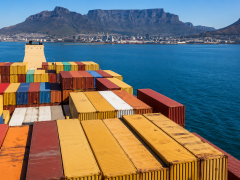
An utter lack of communication from Transnet Freight Rail (TFR) has led to howls of protest from the freight industry. This as the Natcor rail line connecting the Port of Durban to the industrial heartland of Gauteng was shut down for a R117- million maintenance programme from July 15-24 – and only limited sections of the industry had heard anything about it. Natcor is the most important general freight rail route in the country – moving containers from Durban to Johannesburg, Pretoria, Gaborone (Botswana) and Matsapha (Swaziland). It’s not as though these annual shutdowns for maintenance over a period of about 10 days are anything new. It is an established practice by TFR. But, on a line which is the country’s main rail cargo artery, it is anything but acceptable if cargo shippers are not warned in time to make alternative freight movement plans. Also, any complete shutdown for more than two days is an absolute disaster for cargo owners, FTW was told. It’s an especial concern for the likes of the automotive and containerised cargo shippers. TFR itself recognised that its Container & Automotive (CAB) and Agriculture & Bulk Liquid (ABL) business units “have very limited stockpile capacity and therefore cannot afford lengthy total rail network closures. The diverse mixture of clients also means that it is difficult to co-ordinate all their shutdowns with our own”. While the total Natcor shutdown was limited only to the period of July 17-20 with 70% of the train service running on the other days, it was still a disaster without any advance warning. Now a TFR spokesman told FTW that it had “informed all its customers”. But this, in practice, meant only that usual misunderstanding throughout Transnet business units serving the ports that shipping lines are the only customers. No thought of the cargo owners who pay their bills, and the agents handling the clearing and forwarding. And it meant that it was only the lines’ notices to customers that revealed the shutdown to some of the freight industry members. But TFR didn’t inform the industry’s representative bodies, according to Brenda Horne-Ferreira, the newly appointed CEO of the SA Shippers' Council (SASC) – whose members move well over 200 million tonnes of cargo a year. “SASC was not informed directly,” she told FTW. Nor was the SA Association of Freight Forwarders (Saaff), according to Dave Watts, maritime director for the body. Watts was also adamant that the lastminute filtering down of information from the shipping lines still didn’t allow sufficient time for cargo owners and their logistics agents to devise suitable contingency plans. Kevin Martin, chairman of the Durban Harbour Carriers' Association (DHCA) – whose members do all the short-haul container movements to and from the port – was equally “appalled” at the lack of notice. “We’re sick and tired of this (lack of communication),” he said. “They should have let us know in time to get some planning done. But silence, as usual.” He also pooh-poohed the TFR assurance that they would be able to maintain 70% train throughput over the semi-shutdown period. “They can’t even keep to their promised scheduling under normal circumstances,” he said. “So 70% might be alright in theory. But, in practice, it’s likely to be a completely different kettle of fish.” The Road Freight Association (RFA) – whose members handle almost all of the long-haul container movements – was also left out in the cold, according to technical and operations manager, Gavin Kelly. And he agreed that, because TFR suggested that any rail shortfall would have to be moved by road, it would be the RFA members’ trucks that would be liable to have to move most of it. Kelly laughed off the other alternative suggestion from TFR – that shippers could move their containers to Port Elizabeth, where the rail line was unaffected. “In both cases, SA Revenue Service (Sars) customs would have a lot to say – changing your transport mode or destination like that.” Adding further ridicule to the situation was what TPT senior GM (terminals), Zeph Ndlovu, had to say in a phone call. Even he hadn’t received any notice until the morning of July 15 – the first day of the Natcor maintenance shutdown. A definite case of right hands not knowing what left hands were doing. CAPTION Off track … maintenance shut-down without advance warning raises industry hackles.
TFR commuication breakdown sends industry off the rails
Comments | 0
© Now Media. This content is protected by copyright and may not be adapted or republished. If you would like to discuss cooperation opportunities, please contact: editor@freightnews.co.za.