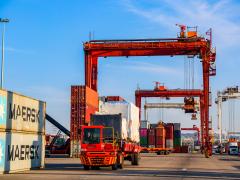
Fears of a “train smash” for the fruit export industry following the announcement of a reefer rates hike early last year have proved groundless with the lines failing to achieve their full objective. Concerns were raised when Maersk declared its intention to increase its reefer (refrigerated containers) rates by a whopping US$1 500 (R12 870) per 40-foot container (FEU). This same sentiment was expressed by most of the other major lines around the world and on the SA trade. The Citrus Growers’ Association’s concern, according to CEO Justin Chadwick, was that: “Transport is 70% of our costs, so an increase of that magnitude (some 30%) will be disastrous. It will even see some companies going out of business.” But the lines didn’t get what they wanted, Peter Newton, Cape Town-based director of Seaboard, told FTW. “What Maersk actually got, we can’t be too precise about. Because, although they have a billing system, they also give various rebates – and rates for individual clients all differ. “But, by and large, I believe it was a failure.” According to Newton, Maersk has from time to time in the last year tried to increase rates. “But they’ve not been having much success,” he added. “It’s all a case of supply/demand. And, if capacity is too high – which it certainly is at the present time – their rates just crumble.” The other lines in the reefer trade have had a similar, and singular, lack of success in pushing up their rates he said. Maersk’s SA MD Jonathan Horn agreed that rates had not risen by the full US$1 500, but expressed the line’s satisfaction with the increases gained – especially on the SA trades. “Ultimately no line is able to dictate a rate increase,” he told FTW. “This will always be determined by the market, which is largely driven by supply and demand fundamentals. While we were not successful in implementing the globally announced US$1 500 rate restoration increase in full, we did achieve significant success in southern Africa in achieving much-needed increases.” He also admitted that Maersk did not have the same degree of success across all corridors. But he did emphasise that these increases were vital in terms of the line’s ability to continue investing in continued development in what is generally a resource-intensive part of its business. “Some volume was indeed lost in the 2013 season due to the rate restoration initiative, but this was well within what was anticipated in our planning,” Horn added. “Overall, however, we achieved a much-needed step-up in our levels of reefer profitability which is ultimately one of our most critical metrics.” INSERT & CAPTION While we were not successful in implementing the globally announced US$1 500 rate restoration increase in full, we did achieve significant success in southern Africa. – Jonathan Horn
Supply and demand dictates level of reefer rates hike
Comments | 0
© Now Media. This content is protected by copyright and may not be adapted or republished. If you would like to discuss cooperation opportunities, please contact: editor@freightnews.co.za.