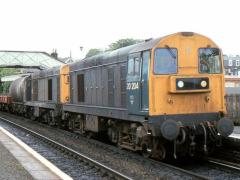
Five-year capex budget could rise from R31.5bn to R40bn JOY ORLEK 2008 will be Spoornet’s year of reckoning. That’s when CEO Siyabonga Gama believes the fundamentals within Spoornet will have been restored sufficiently to begin to capture market share from road operators. The rail utility has budgeted capital expenditure of R31.5 billion over the next five years, with hints that this figure could be increased to R40bn, with general freight business (GFB) one of the major beneficiaries. Its aim is to move 226 million tons overall by 2008/9, up from 180mt in 2005/6. To achieve this it will acquire 374 new locomotives at a total estimated cost of R8.5 billion and will upgrade 514 locomotives at a cost of R3.7bn. “Our turnaround is not a one-year process. The key for us is to ensure that it’s sustainable which is why we are not taking a short-term, myopic view,” Gama told FTW last week. In line with its focus on freight, the company has already started divesting from non-core, non-freight activities. The Blue Train is for sale and Shosholoza Meyl will be transferred to the SARCC next year. “The key is to stabilise. We have stopped the downward trend and are getting ready to move up. “It’s all about regaining the confidence of our customers and creating a credible offering, and that means improving the performance of the business. It’s a key enabler in terms of SA’s competitiveness and we play a key role in SA’s logistics system.” GFB will be a principal focus, says Gama, who concedes that it’s always been the “orphan”. “We have concentrated on coal and iron ore to the detriment of GFB. Whenever we needed resources we would take them from the GFB. But we are now intent on increasing our general freight market share. “And here we have two scenarios – one which sees GFB moving from the current 80mt to 146mt and a second where it’s doubled to 160mt.” Over the past financial year Spoornet managed to grow turnover by 2.19% from 13.7bn to 14bn. It reduced operating costs by R500m from the previous year and was able to more than double operating profit to R1 695m from R767m. But while there was some improvement in coal and iron ore volumes, the drop in GFB from 86.1mt to 83.8mt was a major blow. “That’s the crux of the matter,” says Gama, and a number of challenges lie ahead to turn this around. “The last delivery of new rolling stock was in 1992. “The youngest locomotive is 14 years old, and the oldest 45. In global class one railways the average age is 12 years. “We also have a very bad record of maintenance. Whenever people wanted to show profits in the past they cut the maintenance. “The chickens have now come home to roost and we have to address this thing once and for all.” In June this year 6000 of Spoornet’s technical employees moved across to Transwerk where the singular focus is ensuring that locomotives are available and reliable. The initial thrust has been on the coal line where there has been a 65% improvement in locomotive availability, he said. But GFB business, where locomotive availability has been a huge problem, is getting strong attention. “Last week we put in eight additional 10E locomotives from the workshop, capacity that had not been there for two years,” says Gama. “We are also working towards creating capacity and an announcement will be made in November in this regard.” But the problems are manifold - the global shortage of wheel centres being one of them. “A lot of our very profitable wagons are lying idle as we wait for wheel centres. We have spoken to suppliers in Australia and Italy but it will take us to the middle of next year to clear the backlog. “We need 8000 per month. At moment we get deliveries of 4000 to 6000. To catch up the backlog we’ll need 10 000.” There’s also an R8bn maintenance backlog that the company is trying to deal with over the next five years. But despite these challenges, Gama is confident that Spoornet is on track for a 2008 turnaround.
Spoornet predicts 2008 comeback
Comments | 0
© Now Media. This content is protected by copyright and may not be adapted or republished. If you would like to discuss cooperation opportunities, please contact: editor@freightnews.co.za.