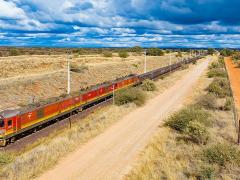
SPOORNET IS fully aware of its massive shortage of rolling stock and the need to reassign wagons caught up in less rewarding and more costly business to major clients. "Spoornet wants to finally shake off the common carrier perception by providing its Top 50 customers that account for the bulk of its revenue with a priority service," says media officer Mike Asefovitz. In this way, he says, Spoornet plans to revise its service offerings to include three traffic categories. These will be (A) for large regular consignments, (B) for large irregular consignments and (C) for small consignments. A and C trains will then operate according to a pre-agreed fixed schedule, while B trains can be chartered to suit customer's requirements, such as an individual import or export consignments. "Where Spoornet needs to cater for new business, it will seek long-term partnerships with a view to sharing the risk of capital expenditure in new rolling stock and infrastructure," says Asefovitz. "In the long term, Spoornet not only requires certainty on what the market requires, but is prepared to collaborate in a transparent manner to the mutual benefit of all stakeholders." These were decisions taken after senior Spoornet management met a delegation from Alpha Cement recently to discuss constraints that currently plague the parastatal. The meeting was called to establish a long term strategy to serve the burgeoning rail operation that, for a long time, has seen little infrastructural growth within South Africa. Asefovitz agrees that the cement industry is just one of many which has suffered financially both because of delays and lack of rolling stock, forcing many manufacturers to switch to the more costly road option. At a subsequent meeting with the hard-hit ferrochrome industry, a Spoornet spokesman declared: "We are pulling out all the stops to make this work, but it will take at least two years before our customers reap any benefits. "Buying a new locomotive isn't like walking into a motor car showroom and signing up your new purchase," says Asefovitz. "The same goes for wagons. They take a good deal more negotiation and expenditure than buying a trailer to hitch onto your car. We have a backlog in both materials and finance, a legacy left from the pre-1990s. It's a matter of concern to every senior Spoornet manager and every effort is being made to address it. In the end we will succeed, but it will be a while before we get there."
Spoornet maps out its plan of action
Comments | 0
© Now Media. This content is protected by copyright and may not be adapted or republished. If you would like to discuss cooperation opportunities, please contact: editor@freightnews.co.za.