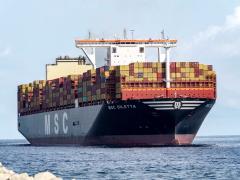
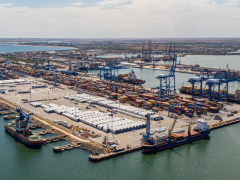
‘A lot of opportunities likely to flow from Trans Caprivi Corridor’ KEVIN MAYHEW DESPITE THE struggling fishing industry Maersk Line Namibia has maintained its volumes with the biggest growth recorded in container movements, according to managing director David Williams. The company benefited from the containerisation of production from the Skorpion Zinc Mine in Rosh Pinah that was transported out of Luderitz. This had a significant impact on its performance. “In terms of volumes, this was a major addition to the performance of Maersk in Namibia,” he said. On the P&O acquisition by Maersk Line and its impact, Williams said that it had been limited as P&O had taken a decision in early 2005 to focus on its core markets in South Africa and not on markets outside of that to any significant degree. He said that Maersk’s liner service directly from South America had reverted to a fortnightly frequency in 2005, due to congestion and delays in Luanda. Luanda continues to be served on a weekly basis through a second loop calling Tema, Ghana then Luanda, and back to South America. He said that Maersk had bedded down its management team to position itself to meet the future demands of its clients in Namibia and to take advantage of new opportunities. Referring to the developments that are taking place at Walvis Bay port, he said that the key players were always in contact with each other and seeking solutions to any problems that are anticipated or experienced. “Where we have concerns there is an open door policy and we can work with Namport or whomever so that the problems can be dealt with in time, whether it is handling of containers or documentation problems,” Williams added. With the Walvis Bay Corridor Group (WBCG) now entering its second five year cycle as a representative body for the private and public sector involved in the development of the corridors feeding Walvis Bay and the port, he said that he was satisfied that it had established its goals realistically for the next five years. “We see a lot of opportunities flowing from the Trans Caprivi Corridor in particular as it gains more acceptance as an alternative for southern African freight traffic traditionally being routed through mainly Durban to Lusaka in Zambia,” he said.
Skorpion mine bulks up container volumes
Comments | 0
© Now Media. This content is protected by copyright and may not be adapted or republished. If you would like to discuss cooperation opportunities, please contact: editor@freightnews.co.za.