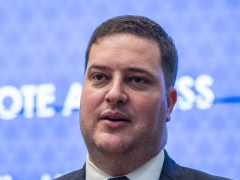
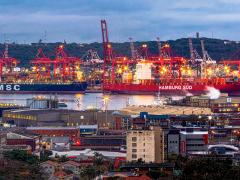
While mergers and acquisitions appear to be a growing trend in the logistics industry, it’s less evident among shipping lines where operational consolidation with a lot more vessel sharing agreements appears to be the order of the day, “The industry is very fragmented and the results everyone is publishing aren’t sustainable on a macro level,” says Safmarine CEO Grant Daly. “Globally consolidation needs to move a bit further into the commercial sphere,” he added. “The industry is in a very tough place,” Safmarine’s southern Africa cluster executive Jonathan Horn added. “We’re all standing on a burning platform, and while the immediate focus is returning to a state of profitability – that’s not good enough. You have to get to the level where you’re making an acceptable return on investment for your shareholder, which is why there’s a lot of focus on rates in addition to cost-reduction measures. “We fully understand our customers are under pressure but at end of the day we have to make sure we are here in 10 years’ time.” Several interventions are in place to cut costs and so achieve that profitability, slow steaming among them. “And it has many positive benefits in terms of reliability and impact on the environment,” says Daly. “There’s also an operational consequence that you are consuming less fuel. We feel we’re not impacting on the reliability or quality of the service we offer but it’s a very important initiative to address our cost base.” And addressing that cost base becomes all the more critical when dealing with issues like congestion at South Africa’s biggest port – which is likely to get worse before it gets better. While the industry is in full agreement that the investment in Durban over the next several years is very positive for our economy and supply chains and is key to keeping South Africa competitive on the world stage, there will clearly be disruptions that will need to be dealt with as they arise. Apart from the thousands of dollars per day that it costs for a vessel waiting to berth, there’s the additional cost in terms of fuel consumption because the vessel has to speed up to get back into sequence. “All schedules have a small degree of buffer – but when you’re speeding up there are huge impacts in terms of bunker consumption if you are spending a lot of time waiting.”
‘Shipping lines standing on a burning platform’
Comments | 0
© Now Media. This content is protected by copyright and may not be adapted or republished. If you would like to discuss cooperation opportunities, please contact: editor@freightnews.co.za.