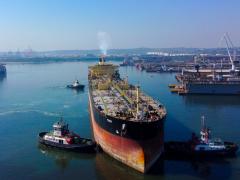
Africa is increasingly becoming a focus for many of the major sea carriers, and the fact that the gross domestic product (GDP) growth rates for the major African countries is now well above the international levels is making that focus even keener. Maritime transport represents 90% of the foreign trade volume of West and Central African (WCA) countries, and containerisation is growing rapidly in Africa at the pace of more than 10% annually. In recent years, containerised traffic in WCA grew even faster than world containerised traffic. It is also interesting to note that the average sub- Saharan African country is today over 30% more open to international trade than in1960. So, the growing interest in the rest of Africa for shipping is reflected in SA trade, and amongst lines which currently also serve this country. What is their focus on Africa? CMA CGM has four services targeting African destinations. Its African Express service sails a schedule from the Far East to Cape Town, Pointe Noire, Tema, and return to Cape Town then the Far East. Asi-Asaf serves Far East-Port Elizabeth-Walvis Bay-Pointe Noire-Luanda-Walvis Bay- Cape Town-Durban-Far East. Midas serves both the Gulf and India, connecting to SA and West Africa. And, from the December 14 arrival of the Flora Delmas in Cape Town, the Mother City will be added to the present Port Elizabeth call on the eastbound leg of the service. With this additional Cape Town call, according to MD Arnaud Thibault, CMA CGM will be offering SA dry and reefer exporters a new opportunity to develop their business to the Middle East Gulf. This with a 19-day transit time to Jebel Ali – from where cargo can be relayed to all Middle East Gulf destinations. Added to that will be a direct service to India, calling at Mundra, the gateway to North India, from Gujarat to Delhi. The line also has the Mozex service, which was one of the early liner services into the Mozambican port of Maputo, and also services the Indian Ocean islands and East Africa. The main activity of Maritime Carrier Shipping (Macs) is offering the only multipurpose liner service between the UK/Europe and southern Africa. This offers a frequency of every 10-12 days, with seven vessels serving southern Africa to the North West Continent. It limits its other African port calls to Walvis Bay and Maputo. But both of these are distribution points for cargoes to or from neighbouring states – like Angola, DRC and Zambia in the case of Walvis, and Zimbabwe, Zambia and Tanzania for Maputo, according to Macs commercial manager, Marc Frauendorf. But there are on-going delays in Walvis Bay, which is under too much pressure from lots of lines using it as a transhipment hub into West Africa, said Frauendorf, forcing the line to implement a congestion surcharge. From December 1 this is fixed at: US$150 per TEU for all GP containers, and US$250 per TEU for all reefer containers, for all new bookings and contract cargo loaded in and destined to Walvis Bay. “However he added, “we will continue to monitor port performance in Walvis Bay and reduce or withdraw the congestion surcharge when a significant reduction in delays has been achieved.” Niledutch connects the region directly with SA, South America, Asia and Europe. An extensive network of feeder vessels in West Africa offers further opportunities of shipping between various West African ports. “Luanda in Angola is a key hub for NileDutch,” said GM Costa Vlassis, “because our vessels call at 5M Terminal in Luanda – which means the receiver can take direct delivery from the terminal, thus saving US$300 per TEU. “Also, at 5M the receiver enjoys five days free – and containers can remain at the terminal for at least 10 days, and a staggered storage rate per day after the fifth day applies.” The line’s focus is on Africa, as NileDutch has increased vessel capacity and sailings into West Africa, preparing the way for 2013 when the first of four brand new, specially built vessels will be introduced. Mediterranean Shipping Company (MSC) plays an integral role in the economy and development of Africa, according to marketing manager, Glenn Delve. “This especially within the mining sector where there is a continued need for equipment and consumables and the extraction and export of mineral mining resources which are in abundance. “Shipping is an intricate and key role player in the economy. It provides an inexpensive yet expansive option of transport and opportunity. It is especially viable in transport of containerised bulk commodities.” Africa is a strategic development continent for MSC, with the line now serving all major Africa ports on a weekly basis. West Africa will soon have a completely revamped service, employing five vessels of 3 000 TEU capacity. Calls are to be made at the ports of Lagos, Abidjan, Lome, San Pedro, Libreville, Monrovia and Tema amongst others. Maersk Line has added to its extensive coverage of African ports a strengthened focus on East Africa. Previously known as the Kenya Cluster, the new East Africa Cluster is a name change that comes at an important time, according to the line, with East Africa gaining importance as an emerging market. In the commercial structure of Maersk Line, according to commercial manager, Kerry Rosser, a cluster is a group of countries within a linked geography that fall under a common management structure. “Given this definition,” she said, “the East Africa Cluster includes Kenya, Tanzania, Uganda, Rwanda, Burundi and the world’s newest independent nation, South Sudan.” The East Africa Cluster is currently Maersk Line and Safmarine’s third largest cluster in Africa after southern Africa and central West Africa. CAPTION The 45 000-TEU Safmarine Chachai … purpose-built for the growing trade with Africa.
Shipping lines adapt to growing Africa trade
Comments | 0
© Now Media. This content is protected by copyright and may not be adapted or republished. If you would like to discuss cooperation opportunities, please contact: editor@freightnews.co.za.