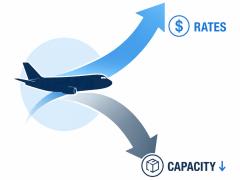
Shippers the world over are bracing themselves for further freight costs with another levy set to be introduced in January when new legislation in Europe and the United States makes it mandatory for carriers to use low sulphur fuel. Surcharge-weary container line customers say they can ill afford any more costs as vessels will need to be adapted to low sulphur fuel. “There is a lot of uncertainty at the moment about the situation and the exact impact,” said Geoff Croxford of table grape grower company Exsa. “Shippers realise they will have to pay more. They just don’t know how much more.” With very little information available, the Global Shippers’ Forum (GSF) last week called for more clarity. “With one or two notable exceptions few shipping lines have yet provided information on their low sulphur fuel strategies – and the extra cost to be passed on to shippers via increased rates or bunker surcharges,” said Chris Welsh, GSF secretary general. “Shippers are under pressure to finalise freight budgets for 2015 and urgently require this information.” Carriers have a range of options to ensure compliance with the new regulations. They can use marine gas oil which meets the 0.15 sulphur content, they can use alternative fuels such as LNG and methanol, or use abatement technology such as scrubbers to dilute exhaust gas sulphur emissions to the required 0.1% sulphur from the current 1%. “The impact on costs will be very different from one shipping line to another,” said industry stalwart Mike Walwyn. Whilst the legislation is only applicable in Europe and North America it will impact significantly on freight rates in South Africa on these routes, he said. “It is questionable how many more surcharges shippers can withstand. At present there is major uncertainty in the South African industry over what exactly the impact will be.” Figures are, however, being bandied about with some saying it could amount to anything from $50 dollars to $200 more per forty-foot equavalent (FFE). Walwyn said it was not possible to speculate because industry was still very much in the dark about the situation. “There is going to be an added cost and that is about all we know at this stage. It is understood that the cost on reefers will be more.” A spokesman for Safmarine, one of the few lines that has provided information on the new surcharge, however confirmed the carrier would introduce a Low Sulphur Surcharge (LSS) on January 1 of $50 per FFE on its South Africa-Europe trade. Twenty foot containers will be charged 50% of the tariff except for trades within the scope of the Transpacific Stabilisation Agreement which will be charged 90%. The spokesman said it would implement an LSS on all its trades with some as low as $30 per FFE and others reaching the $160 per FFE mark depending on how much time was spent in the ECA areas. “To provide transparency on the additional costs we are introducing a separate surcharge instead of integrating costs into our existing bunker surcharge,” said the spokesman. “The LSS will be trade specific and apply to headhaul/ backhaul and dry as well as reefer cargo. We will review surcharge levels quarterly and adjust to reflect costs for low-sulphur fuels." Croxford told FTW ongoing cost increases were starting to take a toll on shippers in South Africa who were already faced with high logistics costs and were far from their traditional markets. “It’s essential though that we get the necessary information about this increased cost now so that we can plan accordingly,” he said. The South African Shippers’ Council was not available for comment.
Shippers brace for new freight levy
Comments | 0
© Now Media. This content is protected by copyright and may not be adapted or republished. If you would like to discuss cooperation opportunities, please contact: editor@freightnews.co.za.