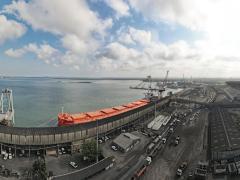
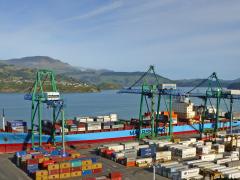
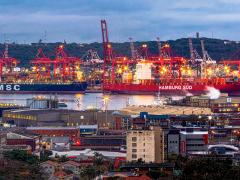
Alan Peat IN A R45-million investment, the Bidfreight subsidiary, SA Bulk Terminals (SABT), is ready to set up records in the high-speed unloading of free-flowing cargoes (like grain, malt and rice) at its Maydon Wharf berths in the Port of Durban. This follows the commissioning of Africa’s fastest and largest grain ship unloader which can handle 800-tons of free-flowing cargo an hour, efficiently discharge 18 000-t a day, and will reduce average berth occupancy at the SABT MW5 terminal from 26 to 10 days a month. Operating in tandem with the existing 290-t/hour unloader, the combined discharging capability is 23 500-t a day, according to SABT MD Koos Smith. “Our unloading capacity at the wharf will increase to 250 000-t a month or three million tons a year – more than the combined capacity of all other bulk terminals in SA. It will really come to fruition when National Ports Authority (NPA) plans for the upgrading of Maydon Wharf’s ship-handling capacity are finally put into practice, which Smith told FTW would be in about five years time. The new unloader is capable of handling fully laden Panamax-sized vessels – but this will only be possible once the Maydon Wharf berths are deepened to accommodate these ships of about 80 000-t deadweight (dwt) and 11.8-m in draft. Until then SABT will have to lighten Panamax-sized vessels at its Island View terminal before the move to the new facility. Smith also feels that the length of the quays will have to be extended to take these vessels of about 230-metres in length – suggesting that Maydon Wharf’s five berths should be reduced to four, as the current 180-m-200-m length is not enough. “Improving port efficiencies is a national priority,” he said, “as it improves our global competitiveness and also reduces pipeline costs on imports to the benefit of the consumer. “The NPA is to be saluted for committing to a major capital expenditure programme to facilitate the handling of larger vessels in the Port of Durban. This is a strategic process, and will take some time, but must be included in the future planning of private sector fixed investment.”
Ship unloader ready to rewrite the record books
Comments | 0
© Now Media. This content is protected by copyright and may not be adapted or republished. If you would like to discuss cooperation opportunities, please contact: editor@freightnews.co.za.