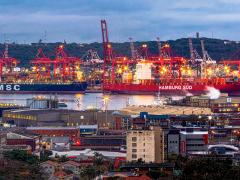
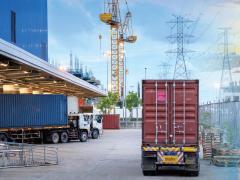
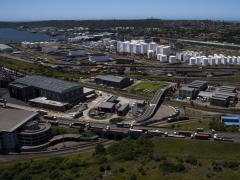
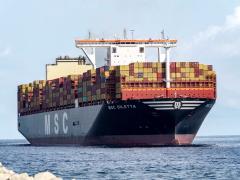
Redesigning the entrance channel is far from all that has been happening in the Port of Durban. Several other large projects have and are taking place, with others in the pipeline. One of those, newly completed, is the Pier 1 Container Terminal, which has been somewhat overshadowed by the development of the Ngqura Container Terminal even though Pier 1 offers a similar capacity and ultimately the same facilities as does Ngqura. Built on the site of the Pier 1 Multi Purpose Terminal on the south of the harbour, the new container terminal consists of three berths, although only two are generally in use. These currently have draught restrictions of 12.8m although proposals are in hand to deepen the berths and provide a 16m depth alongside. What the terminal does boast is having been equipped with six Super Post-Panamax ship to shore cranes and a fleet of rubber tyre gantry (RTG) cranes to handle the stacking of containers – the first terminal in South Africa to be equipped with RTGs. Pier 1 Container Terminal has an annual design capacity of around 720 000 TEUs and makes use of the Navis SPARC operating system – again the first terminal to do so in South Africa. A new rail terminal has also been completed along with an automated gate complex, in each event pioneering developments for the other terminals. Pier 1 Container Terminal has cost Transnet in the region of R2 billion to develop. A study to extend the terminal into the Salisbury Island complex is currently at feasibility stage – if this proceeds it will add another 800 000 TEUs to the terminal’s overall capacity, yet another similarity with Ngqura. At the adjacent Durban Container Terminal (DCT), upgrading of the actual quayside on the north end of the terminal (berth 203 -205) is currently under way along with the refurbishment of the terminal’s older ship to shore gantry cranes. The terminal has also been equipped with a number of new super Post-Panamax STS cranes and the fleet of over a hundred straddle carriers has been replaced entirely with new Kalmar machines, including a number that are capable of stacking boxes four high. Within DCT’s precincts construction of the relocated workshop buildings and a new multi level parkade for staff vehicles is under way on the outer perimeter of the terminal to create more stacking space within the terminal itself. This terminal will also be converting to the Navis SPARC operating system in the near future – DCT currently makes use of a COSMOS designed system. During 2008 the Port of Durban handled a total of 2.56 million TEUs at all terminals, a slight increase on the previous year but still almost two thirds of the total containers handled at South African ports. Warehouse for soya bean imports under way In other areas of the port a large warehouse with a capacity to store 80 000 tons of soya bean imports is under construction at the Maydon Wharf Agriport Terminal opposite berth 8. Transnet has long-term plans to refurbish the old Maydon Wharf area – the berths date back to the early 1900s and many are extremely shallow in draught and in need of refurbishment. These proposals are currently on hold but if and when the nod is finally given it will entail major engineering to create deeper berths. Transnet also ‘harbours’ an ambition to create clusters of similar-type commodities along the length of the 15 Maydon Wharf berths. Again, due to the current economic downturn, this project has been placed on the back-burner until more favourable times. Still handling 6m tonnes of breakbulk While breakbulk cargo remains a diminishing commodity worldwide it is worthwhile noting that Durban still handles almost six million tonnes of breakbulk – which in itself is greater than the combined cargoes of all types handled at a number of ports in the southern Africa region. The Durban Car Terminal has almost completed an expansion programme taking it to the planned capacity of 14 000 slots. Four dedicated berths are available for the use of car carriers, a unique facility anywhere in southern Africa. In 2008 the Durban Car Terminal handled a total of 372 557 motor units, of which 184 511 were imports, 182 091 exports with the small balance being tranship vehicles. Another area of the port receiving some much-needed attention is the Island View oil and petro-chemical terminal. The complex now houses more than a thousand large storage tanks, making this one of the largest such facilities in the southern hemisphere. The facility is also one of the port’s oldest, dating back to the 1920s when the first tanks were constructed. This construction period extended through into the 1950s when the last of nine berths was opened to shipping although new tanks continue to be erected. However, maintenance work on the berthing area has been badly in need of attention and upgrading is currently under way, with one berth being taken out of service at a time for refurbishment. Several berths have already been completed. Bayhead road upgrade on hold Another project to be placed on hold as a result of the downturn, and one that will probably be roundly criticised by the freight industry for being short-sighted, is the temporary suspension of the Bayhead Road upgrade project. The intention was to extend the double highway aspect of Bayhead Road beyond the Langeberg Road junction (DCT turnoff) to provide improved road facilities and access to the Pier 1 Container Terminal as well as the Island View petro-chemical complex. This included plans for a truck staging area for vehicles using the Pier 1 Container Terminal. Transnet has indicated that it will review the situation during 2010.
Several major projects under way
Comments | 0
© Now Media. This content is protected by copyright and may not be adapted or republished. If you would like to discuss cooperation opportunities, please contact: editor@freightnews.co.za.