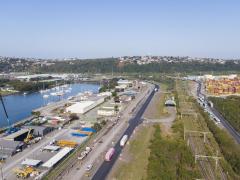
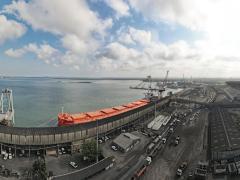
The SA Revenue Service (Sars) customs can’t afford to ignore the critical need for inland ports, according to Pat Corbin of the Johannesburg Chamber of Commerce and Industry (JCCI). The International Chamber of Commerce (ICC), he told FTW, is presently very involved with the relevant United Nations (UN) office in the review of the Almaty Programme which addresses the special needs of landlocked developing countries within a new global framework for transit transport. “And in this the establishment of inland ports (IPs) is of great importance to the development of landlocked countries, not to mention the decongestion of the coastal ports.” The matter is currently of great importance, Corbin added. “The SA parliament is now passing legislation on behalf of the SA Customs Union (Sacu) – which includes three landlocked countries – that will, after 37 years, exclude IPs from the definition of places of entry and exit.” As part of a move by the JCCI to alert Sars to the vital need for the re-establishment of the IP concept, Corbin pointed to last year’s World Trade Organisation (WTO) Bali Trade Facilitation Agreement which, he said, promoted the IPs as an essential tool in the smooth flow along the global supply chains. “This month’s World Customs Organisation (WCO) April 28 Madrid Conference, which I will attend, has an agenda item on this WTO Bali Trade Facilitation Agreement. “It would be most instructive if the conference deliberations could address the obligations of WTO member states under Articles 9 and 11 (‘movement of goods under customs control’ and ‘freedom of transit’).” Under these articles containerised cargo can move seamlessly inland on a vessel’s bonded manifest to a designated place of entry and exit. “That is to an IP by a bonded carrier,” Corbin said. INSERT & CAPTION The establishment of inland ports (IPs) is of great importance to the development of landlocked countries, not to mention the decongestion of the coastal ports. – Pat Corbin
Sars swims againt the global tide
Comments | 0
© Now Media. This content is protected by copyright and may not be adapted or republished. If you would like to discuss cooperation opportunities, please contact: editor@freightnews.co.za.