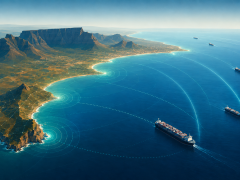
As Far East imports move into their traditional peak, carriers are keeping a close watch on volumes. If these are more evenly spread over 12 months – as was the case last year – it could be a sign that the country has changed its buying and stock patterns and matured as an economy, says Safmarine’s SA trade director Alex de Bruyn. And for the lines that’s positive, because to find extra capacity to cover a three- or four-month peak comes with challenges. Lines have two options to cater for the current peaks and troughs, says De Bruyn. “You can either deploy larger vessels that are in the water year-round, and deal with under-utilisation for six months of the year, or go for middle-of-the-road tonnage and bring in extra peak loaders. “The former means you have under-utilised ships for half the year, but the latter option may put you at the mercy of the charter market. And if you’re taking them on short-term lease you’re paying a premium.” Clearly it’s a fine balancing act – and if buying patterns have smoothed out it will be good for industry, he says. Safmarine, in conjunction with Maersk Line, has clearly chosen option one. The line recently upgraded its joint service and now deploys 6 000-TEU rather than 4 500- TEU vessels on its Safari 1 service into South Africa. In addition it runs a second weekly service (unchanged) into Maputo. “It’s a gamble, but we believe it will provide us with sufficient capacity for the peak,” said De Bruyn. It has also added Ngqura to its Safari 1 port rotation, instead of Port Elizabeth. The line still has high hopes for its Maputo service, but has experienced difficulties on the Maputo Corridor, particularly for imports. And these difficulties relate to all aspects (operations and documentation) of a container moving from Maputo to Gauteng. Safmarine is engaged with all stakeholders to improve the situation,” he said. Turning to exports, De Bruyn points to fairly buoyant volumes, largely thanks to China’s major requirement for base minerals, which now move in containers. “There was a cross-over point in 2004 for the export of minerals which traditionally went in bulk vessels. That was when the charter market for bulk vessels increased significantly and it became viable for exporters to put their minerals in containers – and that’s a trend that has continued, with Safmarine showing strong exports of minerals into Asia and China in particular.” But that too creates challenges because minerals are more suited to 20-foot containers while imports – generally light finished goods – move in 40-footers. “So we have an equipment imbalance problem to deal with – and since minerals are heavy we’re generally not getting good utilisation of vessels in terms of TEUS. “We’re hitting maximum deadweight before we max out on our TEU intake and since we get our revenue per TEU and not per ton, it’s not a great formula.” Containerised reefer exports to Asia meanwhile continue to tick over, but in no way approach the level of volumes on the Europe and Middle East routes. This is probably in part related to the proximity of Asia (and thus its access) to Australia and New Zealand where seasonal supply (and perishable commodity type) is the same as South Africa.
Safari brings on bigger vessels
Comments | 0
© Now Media. This content is protected by copyright and may not be adapted or republished. If you would like to discuss cooperation opportunities, please contact: editor@freightnews.co.za.