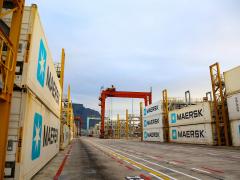
The Citrus Growers’ Association has offered assurances over the future of South Africa’s exports to the EU following the latest CBS (citrus black spot) interception – the fourth this year and one short of this season’s limit placed by the EU on fruit from South Africa. The industry is not at risk of a blanket embargo following this latest development, Citrus Growers’ Association special envoy EU and CBS, Deon Joubert, told FTW. “The EU can at any stage reassess if the SA measures are adequate and mitigating risk. By closing organic lemon exports, SA is demonstrating it is serious and working diligently to ring-fence challenges as they arise,” said Joubert. What’s important, he says, is for the South African industry to understand the process in the EU so that it is better able to mitigate risk to avoid further interceptions. And that was the objective of a high-level delegation of South African experts who were in Europe last week to inspect the procedures used to identify CBS in order to better understand how they are applied. The delegation was invited by DG Sante (the EU directorate-general for health and food safety) as well as Spain, Italy, France, the United Kingdom and Portugal. Last year local growers undertook a similar fact-finding trip – but only to Germany and Holland. Joubert is hopeful that following the visit South Africa will be able to improve its already comprehensive CBS risk management programme. “The whole thing about risk mitigation,” said Joubert, “is that it is a process to fix mistakes and try to sustain those growers who are doing well. That’s been the process for the past two to three years and it’s clearly paying dividends.” It’s important, however, that both sides are reading from the same rule book. “We need to understand how the EU defines CBS symptoms – is it one lesion or is it ten? There needs to be a consistent frame of reference.” Ultimately it’s all about transparency. “If the fruit of one of our growers is intercepted, we send a group of auditors to the farm to check what he’s done, where we could have missed a cue, and once we’ve done the analysis we look at how we can improve the situation. “We want the same access to information in Europe – we want to know how many fruits were involved and any other information with regard to the interception.” There are many South African growers who have been operating for the past 20 years without one interception. “Our purpose is to recognise credible supply lines, fix problem areas and if there’s no solution, to weed them out.” But Joubert believes that despite the substantial efforts made by the South African citrus industry as a whole, no agreement has been reached with the EU since 1992 on the risk of CBS being transmitted by fruit to citrus orchards in the EU – and this has been a point of disagreement for some time. “But the CGA, together with its partners in the South African government, remains committed to working with the EU authorities towards a longterm resolution that will ensure the continued viability of this important market.” “The continuation of citrus exports to Europe is critical to the South African economy,” Maersk Line SA trade manager Matt Conroy told FTW. “We believe that the CGA is taking very proactive measures in addressing these issues and we fully support their efforts.” INSERT & CAPTION Five is an arbitrary figure and another interception will not result in a ban on SA exports. – Deon Joubert
SA works with EU following latest CBS interceptions
Comments | 0
© Now Media. This content is protected by copyright and may not be adapted or republished. If you would like to discuss cooperation opportunities, please contact: editor@freightnews.co.za.