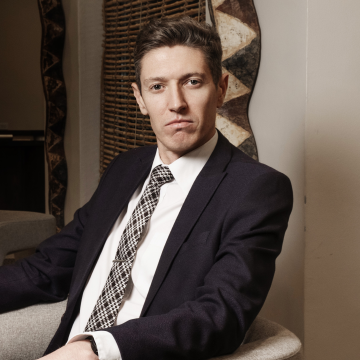
New CEO speaks out on future plans Sipho Khumalo … ‘We are looking at changing dangerous goods legislation and see that special training is needed for drivers in this category.’ It has been a year since Sipho Khumalo took over as CEO of the Road Freight Association – the main road freight industry representative body. Kevin Mayhew talks to him about the first year and what is to come in the road freight sector. FTW: How has your first year been? There must have been frustrations and you spent a lot of time getting to know the industry before you plunged into pushing for changes. SK: It has been a very successful year. Coming here, I had trepidations about how things could go awfully wrong but I did not realise how much support I would enjoy within the RFA. I knew with certainty that the Board of Directors wanted me on board but I also knew that the Board was heavily influenced by key players. And that was a concern of mine as I was very conscious of the history and past of the country and this industry. Being a black man coming into the historically white organisation was a very real consideration as it could have caused many different results. FTW: And, what happened? I must say that on the whole I have been very well received. I took the trouble to visit everybody and drove my programme of action hard, making it clear where I believed the changes were needed and articulating my feelings in consultation with all players. Several dissatisfied members believed that they were paying good money and seeing nothing for it – simple as that. We have now provided members with a comprehensive programme of action for the whole year. FTW: What are the key areas of that programme? SK: We have started delivering on the ground and now we get very good positive feedback from people who are starting to experience change. Almost every month we have a training seminar on one topic or another that benefits our members. We are looking at changing dangerous goods legislation and see that special training is needed for drivers in this category. We are building up to forming an RFA training academy. We have begun a limited but effective call centre to handle problems our members are having on the road. For instance if there is a breakdown we can give your driver guidance as to where the nearest repair tow truck assistance is situated. The question of our office closing at 4:30pm and you cannot get any help is a big problem, but we cannot immediately establish a major costly infrastructure and then the service proves to be not what the market wants. So we are beginning small and building on the service. We want it to be become a 24 hour facility but there are cost implications. The little that we have done to date appears to have been appreciated by members. FTW: Technology should make your job a lot easier. SK: There was no website when I started here. Now people have noted that something good is coming out of the new structure. You still have people saying it is not enough, and there are people who still fall outside of this communication loop for whatever reasons. The personal touch is vital. In Durban we arranged eight appointments with Indian operators who are members of the RFA. The outcome was that we saw that they were still unclear about the RFA and its changes, as the communication loop had not been embraced by them, probably because they did not know about it. However, they were very impressed by the fact that, for the first time in all the years they have been members of the RFA, someone from the Association has bothered to come to their offices to establish what their needs are. FTW: How is the overloading accreditation drive going? Have you rolled that out? SK: We did the pilot in the timber industry and have got all that we could gather from that. Now our challenge is to roll this initiative out on a national scale. To do this we need political will from Government’s side. Hence the reason I have had meetings with the national transport minister. We want him to support and endorse the Load Accreditation Programme (LAP) and make a policy announcement on it. People are saying to us “if you expect me to do all these nice things what is in it for me, why should I allow this situation where my competition can undercut me.” Essentially they are saying that the more they stay on the legal side the more they are disadvantaged. So they must know that they will enjoy certain benefits from participating in LAP .Then there is a good chance that we will win the overloading challenge. To roll it out to the rest of the country, it becomes clear that what is needed is high level guidance from Government, and that’s where we are focusing our energies at the moment FTW: Is government committing enough money to road infrastructure compared with the vast sums that Transnet is talking about for the rail infrastructure? SK: When it comes to Government and you consider the Department of Transport’s national logistics strategy, you realise this is not a national logistics strategy, it is a railway corridor strategy. And that’s a problem because everybody acknowledges that at least 80% or more of everything that moves is moved by road transport. But now we have this massive intervention that is going to cost the country billions of rands that is aimed at sorting out the area of 20% or even less of what gets moved. So, if we talk on the broader level about unblocking the bottlenecks in the logistics system, then the interventions are limited to 20% as opposed to 80%, so you are not really focusing a solution correctly. It is likely that whatever interventions are made will not actually yield the intended benefits because you have not looked at the entirety of the problem. There must be a correlation between the interventions we make and the intended outcomes. Otherwise we will end up with a situation where we spend R18bn on Spoornet and then five years later find that it has not made any difference and we continue to sit with a bottleneck. There is a lot more that is needed to sort out the Spoornet problem. I am not sure if you want to start by throwing money at a problem and hope that things get sorted out or whether you want to streamline the operational issues and only when you know what the remaining problems are you can look at developing the infrastructure upon which it can operate competitively. FTW: Is it the RFA’s policy or attitude that there are definitely different types of goods that are better transported by rail than by road? SK: Yes we are very open about that. We always look at things with a long sustainability perspective. If you continue to transport goods that ought to be transported on rail by road we are damaging the road infrastructure and we get to the point where we cannot even transport freight that ought to be transported by road, because the roads will be in the same state that rail is in. FTW: To what extent are organisations like the RFA being absorbed into this debate? Are you part of a cluster that involves Spoornet, Transnet, and the ports. As the main rival you seem to be the enemy, are they engaging you? SK: In short we are not being engaged and yet if you took away the trucks that travel the roads, the SA economy would literally be at a standstill. One cannot wish road transport away as the reality is that the sector sustaining the economy as we speak is road transportation. Rail should understand that it is no good shunning road if it is the successful alternative, but rather learn from us. We road guys are not oblivious of the fact that there is freight that ought to be moved by rail. There is no better place to get pointers to competitiveness within Spoornet than by looking at road.
RFA plans training academy
Comments | 0
© Now Media. This content is protected by copyright and may not be adapted or republished. If you would like to discuss cooperation opportunities, please contact: editor@freightnews.co.za.