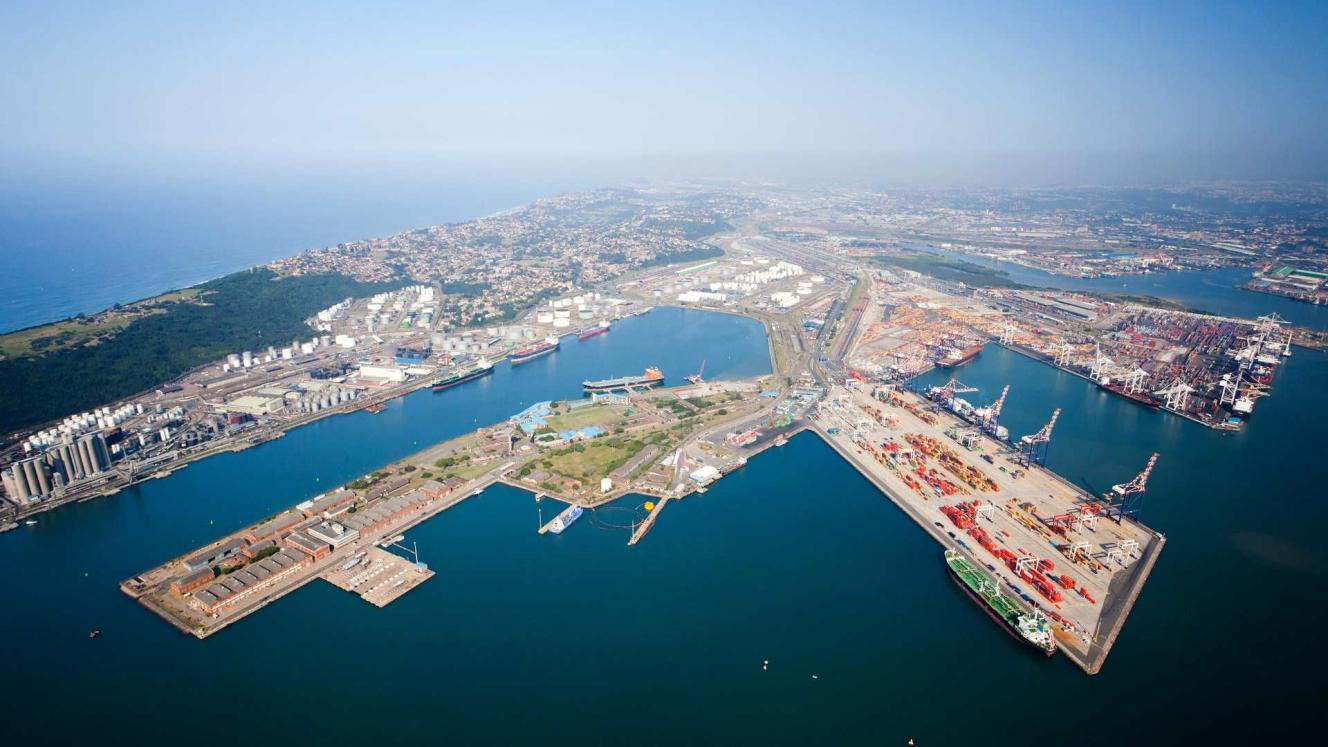
The growing volume of
transhipment cargo doesn’t
imply that every African
port should develop itself
as a hub.
“We cannot all be hubs,”
said Nozipho Mdawe,
secretary
general
of Ports
Management
Association
of Eastern
and Southern
Africa
(PMAESA).
“There are
certain ports
that cannot
be hubs.
South Africa,
Tanzania,
Kenya, Djibouti,
Madagascar, Mauritius –
every single one is a hub.
It will not work. We have
to approach this regionally
and collaboratively or it is
going to fail for everyone.”
According to Vishaal
Lutchman, divisional
director WSP Group
Africa, there’s a trend
towards the creation of
hubs across the continent.
“There is an increased
number of hub options in
East Africa, Indian Ocean,
Indian sub-continent
and South
Africa. Is our
planning in
South Africa,
for example,
inherently
assuming
that we will
be competing
directly with
the EAC?”
He said
South
Africa had
implemented
a complementary port
system that had proven to
be highly successful and
there was no reason why
this could not be extended
across Southern and East
Africa.
“We have to ask ourselves
how a regional approach
can assist in managing
competition whilst
making better use of
infrastructure,” he said.
Currently, planned
capacity increases in
Kenya, Tanzania and the
Indian Ocean Islands
(Reunion, Mauritius
and Madagascar) would
put massive pressure on
traditional transhipment
hubs in South Africa
as they are operating at
present.
“What do those
developments mean for
Ngqura? We all know
that transhipments are
price sensitive, but we
control the pricing,” said
Lutchman. “At the same
time new service structures
will see the introduction
of larger tonnage and
consolidation of volumes at
major transhipment hubs
across the region. We are
in a position as regions to
decide where these hubs
will be.”
He said Southern and
East Africa were far better
suited to work together and
plan and integrate which
ports should be hubs rather
than just developing and
then fighting over volumes.
Mdawe said it was
crucial to look at the
requirements of a hub and
what ensured success.
Elements such as the
geographic location, the
available facilities and
capability, capacity and
performance were crucial
considerations.
“We have to look at each
and every port individually
and then regionally. What
can South African ports
offer that Djibouti does
not have to and what can
Dar es Salaam do without
Maputo having to invest
in the same things? We
have to take a big picture
view or face some very
real consequences,” said
Mdawe.
Lutchman said the
reality was that some
ports would simply just
have to settle for feeder
port status or look to
other shipping sectors
for service opportunities.
Aspects such as how much
bureaucracy was involved
to move cargo in or out of
a port could very well be a
major consideration when
choosing which hub to use.
“Some ports may not
need to be developed at
all,” he said.
INSERT
We have to take a
big picture view or
face some very real
consequences.
– Nozipho Mdawe
‘Regional approach to transhipment hubs the only way to go’
Comments | 0
© Now Media. This content is protected by copyright and may not be adapted or republished. If you would like to discuss cooperation opportunities, please contact: editor@freightnews.co.za.