South Africa’s agricultural export revenue climbed sharply through 2025, with total export receipts reaching an estimated US$11.7 billion to date, driven in large part by refrigerated shipments that depend on reliable cold-chain logistics.
According to a statement released by Mediterranean Shipping Company (MSC), the country’s perishables sector has seen consistent growth over the last five years.
This has been underpinned by strong agricultural exports, particularly citrus, table grapes, apples and pears.
MSC, which has been heavily investing in services for the sector, including infrastructure through its logistics and warehousing division, Medlog, says perishable sector exports “have South Africa’s calling card on the world stage”.
Zane Godwin, national export commercial executive for MSC South Africa, says the carrier saw record reefer volumes shipped from these shores in 2025.
He adds that it reflects the strength and resilience of global demand for fresh produce and chilled cargo.
“Today, reefer cargo accounts for almost one-third of our total business out of South Africa, with around half of those volumes moving into European markets. It’s a clear sign of the trust exporters place in MSC to move their most time- and temperature-sensitive goods reliably, season after season.”
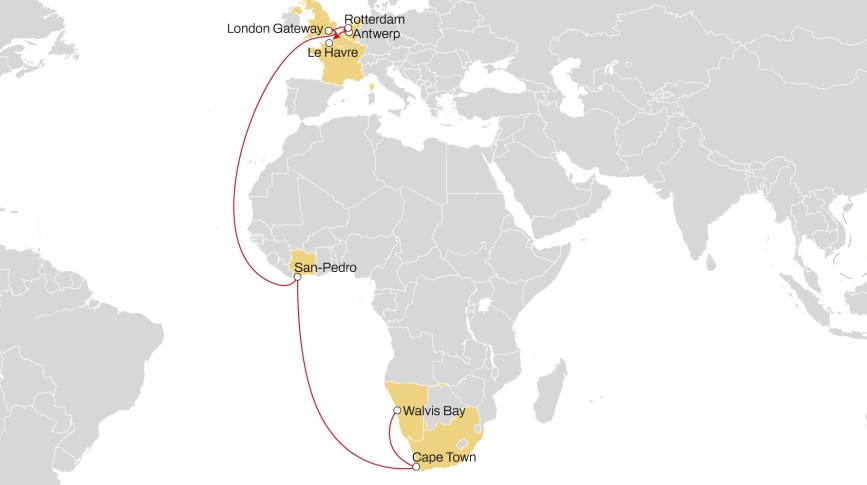
The line emphasises that, to support this growth, it recently introduced a Western Cape Express service, “which enhances and completes our current NWC (North-West Continent)-South Africa and NWC-Morocco-WAF (West Africa) Service networks, ensuring reinforced coverage during the fruit picking season”.
“This service seamlessly connects key South African ports with major European gateways, offering shippers enhanced reliability and transit times during peak seasons – a critical advantage for fruit exporters and other temperature-sensitive product owners.”
In addition to the Walvis Bay-Cape Town-San Pedro-London Gateway-Rotterdam-Antwerp-Le Havre-service, in late 2025 MSC also launched its USWASA Express service, connecting the US with West Africa and SA.
The standalone service provides a direct link with the following East Coast ports: New York, Baltimore, Savannah and more, “empowering importers and exporters alike to tap into thriving transatlantic trade corridors with improved connections”, MSC says.
Given the need for temperature-sensitive capacity on the back of surging trade in perishables, MSC says it is backing its ocean services with robust cold-chain infrastructure.
Medlog’s relatively new cold-store facility in Durban “adds approximately 15 000 square metres of temperature-controlled space, giving exporters and importers a state-of-the-art platform that supports both chilled and frozen cargoes with full regulatory traceability”.
“The facility enhances South Africa’s competitiveness, reducing time-to-market for perishable products and strengthening the entire export ecosystem from farm gate to final destination.”
Across the Atlantic, Medlog has also expanded its footprint in Savannah, Georgia, fulfilling “a similarly strategic role”.
“Serving as a critical node on transatlantic reefer routes, the Savannah facility supports efficient handling of perishables moving into and out of North America,” says MSC.
“These investments not only bolster global cold-chain capacity, they are highly beneficial for meat importers and exporters, enabling greater visibility and integrity across international routes as well as regional intra-Africa supply chains where chilled and frozen meat products are increasingly moving between markets.”