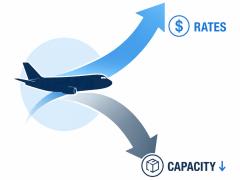
The first half of 2026 has proved far more turbulent for global airfreight than initially anticipated, with conflict in the Middle East disrupting capacity, pushing up rates and halting the expected shift of cargo back to ocean freight. Xeneta data shows that global airfreight demand remained resilient despite the disruption, increasing by 7% year on year in June after contracting by 3% in March. Demand growth for the year is now tracking at around 3%, at the upper end of Xeneta’s original forecast of 2-3%. Peter Sand, chief analyst at Xeneta, said global capacity had increased by 3% year on year in June, recovering from a 6% contraction in March and a further 1% decline in April. However, Xeneta has revised its full-year capacity growth forecast from 3-4% to 2-3% due to the impact of the conflict. “It has been an interesting but highly turbulent period for airfreight,” said Sand. “Considering the importance of the Middle East as a hub for global airfreight supply chains, it is not surprising that the year has unfolded very differently from what we anticipated at the end of 2025.” At the height of the disruption, outbound capacity from the Middle East fell by more than 90%, affecting major transhipment hubs connecting Asia with Europe and, to a lesser extent, the east coast of North America. Sand said the disruption and resulting market pressure were unlikely to ease significantly in the near term. “We expect rates and capacity pressures to remain elevated for the rest of the year because uncertainty surrounding the Middle East is unlikely to peter out anytime soon.” On the upside, the sector has recorded solid demand growth in recent weeks. “Considering the contraction recorded in March and the subsequent recovery, there is clearly no such thing as a dull day in the airfreight market,” said Sand. The combination of disrupted capacity and recovering demand has pushed up airfreight rates across most major trade lanes. Xeneta initially expected shipper rates to decline by between 5% and 10% this year but now forecasts an increase of between 5% and 15%. Global rates were 38% higher year on year in June, with the average spot rate reaching $3.40 per kilogram. The transatlantic market was the notable exception, recording a decline of around 25%. Sand cautioned that the divergence between trade lanes meant businesses could not rely on global rate indicators alone. “You need to examine individual trade lanes and understand how developments affect your company’s specific needs,” he said. The global dynamic load factor stood at 62% in June, three percentage points higher than a year earlier. LV
Rates expected to increase
Comments | 0
© Now Media. This content is protected by copyright and may not be adapted or republished. If you would like to discuss cooperation opportunities, please contact: editor@freightnews.co.za.