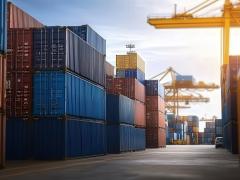
A new phrase in the shipping industry lexicon is operational merger, a tactic that is becoming increasingly prevalent as individual lines struggle for survival in the world’s cut-throat competitive main trades from Asia to Europe and the US. These trades are currently in the tragic position of having a growing surplus of tonnage faced with an everdecreasing demand, and rates that have plummeted to undercost levels. This urge for these operational partnerships, and their resultant rationalisation, was triggered by AP Moller- Maersk, the world’s biggest container line, merging some of its trades on the Asia- Europe route into a fixed daily service in September. The first out of the blocks after this were MSC and CMA CGM, the world’s second- and third-largest container lines, agreeing early in December to co-operate on Asia-Europe routes, as part of a wider partnership designed to pare overcapacity and improve service levels. This was followed by an alliance formed on December 22 by Neptune Orient Lines, Hapag-Lloyd, Orient Overseas Container Line, Hyundai Merchant Marine, Nippon Yusen KK (NYK) and Mitsui OSK Lines (MOL), for the Asia-Europe trade (the world’s busiest) as they co-operated to curb falling rates amid the slowing demand and overcapacity. The companies plan to deploy more than 90 ships to provide nine services that will call on more than 40 ports, the lines said in a joint statement. The new alliance will start operations by April, they said. A week later, another operational merger was announced. China Cosco Holdings (Asia’s largest shipping line), Evergreen Line, Hanjin Shipping, Yang Ming Line and Kawasaki Kisen Kaisha (K-Line) also decided to form a partnership for the Asia-Europe trade. According to a Bloomberg (Asia) report forwarded to FTW by the head office of a Far East container shipping line, rates may rise next year as owners join hands to overcome the collapse in fees amid slowing trade growth, according to RS Platou Markets. Also, said Cho Byung Hee, an analyst at Kiwoom Securities in Seoul: “Through these partnerships, shipping lines will be able to reduce costs by sharing resources. It’s now become ever more difficult for shipping lines that are not part of any partnerships to survive on the Asia-Europe trade.” The sheer size of the problem is revealed by the spot rates for hauling a 20-foot (6-metre) cargo box to Europe from Asia. They fell 62% last year to US$536 at the end of December, according to the Shanghai Shipping Exchange. The break-even point on the route is at least US$700, according to Morgan Stanley. Demand for cargoes to Europe from Asia is expected to expand 3% this year while the fleet of container ships swells 8%, according to Clarkson, the world’s biggest shipbroker. Another piece of bad news is contained in the latest International Monetary Fund (IMF) estimates. They summarise that world trade will expand 5.8% in 2012, down from a previous forecast of 6.7%. Highlighting the only other answer to overtonnaging on global trades is the Parisbased maritime data provider, Alphaliner. It said in its endof- the-year weekly newsletter that a total of 219 ships with a capacity of 546 000 TEUs were idle as of December 19, an increase from 526 000 two weeks before. They also noted that shipowners scrapped the most container vessels in two years in the last month of the year. Meanwhile, on the local scene there is an equal amount of chagrin about the state of play on the world’s biggest trade. “These partnerships are being formed for sheer survival in the Far East- Europe trade,” an unnamed SA-based executive of a Far East shipping line told FTW. “More will surely follow. “In my opinion, the only way other smaller carriers are going to have a future against the giants of Maersk, MSC and CMA-CGM will be to form packs or alliances in business. The old Conferencestyle system seems to be reappearing.” But, he asked, how will the world’s competition boards adjust to such a business concept developing purely for business survival? “Will they review their anti-trust (competition) laws to become more accepting, and to suit the forced changes stemming from the global financial crisis, which will be pressurising business decisions in future?” Local line executives have also told FTW that this operational merger trend will also likely ripple down onto the SA-Asia trade – where there is also serious overtonnaging and slackening demand. They suggested that larger vessels (formerly on larger-volume routes) were already appearing on the trade, allowing for a possible rationalisation of the service frequencies. They also hinted that the current situation saw proposed rate hikes and peakseason surcharges having been cancelled, and ratecutting beginning to appear amongst the most troubled of the carriers.
Rate rises predicted as operational mergers take hold
Comments | 0
© Now Media. This content is protected by copyright and may not be adapted or republished. If you would like to discuss cooperation opportunities, please contact: editor@freightnews.co.za.