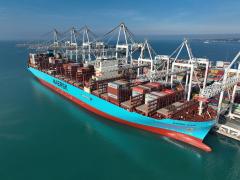
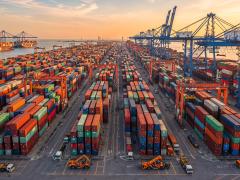
SA manganese ore exports haven’t taken the hard hit that other export sectors have during the global crisis, according to Iain McIntosh, trade and marketing director of Mitsui OSK Line (MOL). This has been supported mainly by China’s continued appetite for steel production even during the tough times of the past couple of years. “Steel production recovered globally from late 2009 – and more so in 2010,” said his manganese exports’ case study commissioned by Dry Cargo International. “China still produced significant increases even in 2009, so SA exports of manganese ore weathered the global crisis quite well. “It also looks set to increase volumes further in 2010 and into the future.” SA clearly has a big advantage in the supply of this mineral. It is one of only a few suppliers of this valuable ore – and boasts some 80% of global reserves. “Demand over the period 2010-2015 looks likely to provide significant volume growth,” said McIntosh. But there are challenges, he added. Like most bulk resource in this country, its mining sources are a considerable distance from the ports – with all the cost disadvantages of long-haul landside transport. “It requires a good supply chain to port to keep down the free-on-board (FOB) costs,” said McIntosh. There are three main producers – Samancor (BHP), Assmang and United Manganese of Kalahari. The ore is mined in the north-west of the country in what has been named the Kalahari Manganese Field (KMF) – and despatched by train from Hotazel through either Port Elizabeth or Durban as the shipment points. For local steel production needs, some of the ore is also moved by road to Johannesburg. Volumes are set to reach over five-million tonnes this year. Whilst Durban moves around one-million tonnes (mt), with about 15% containerised, the main gateway for bulk exports remains through the Port Elizabeth manganese bulk terminal – which, at about 1 100-kilometres, is closer to the mining area. “The efficiency of this specific supply chain is critical in terms of the volume growth of this product from SA,” McIntosh said. “And the essential driver for available tonnage of exports is a good rail system.” The Transnet Freight Rail (TFR) network supplies capacity for 4.6-mt per annum. The port of PE handled 3.2-mt of bulk ore during 2009 and is expected to exceed 3.5-mt this year. “So,” said McIntosh, “there is room for further growth in port volume given the rail capacity available. “However, that available rail capacity begins to look tight if you look at the short-term demands for ore exports. “Mine capacity is currently restricted to around six to seven million tonnes a year. But the demand in the shorter term is more in the region of 14-mt.” A number of developments are under way to realise this potential, McIntosh told FTW. At the rail loading end, a rapid load-out station installed by Bateman Engineered Technologies (BET) is just part of an overall plan to improve efficiencies. Aside from accurate load distribution, the station has a design capacity to load 2 000-tonnes per hour (t/h) – and a 104-wagon train can be turned in just over three hours. But, said McIntosh, in practice it has been found that the station actually has a capacity to load 7000-t/h. Meantime, the PE bulk terminal has had an upgrade costing the equivalent of over R380.8-m in the last 18-months. It has a 251- metre berth of 11.6-m draught fed by two loaders each with 400-600-t/h capacity. Therefore, with its 460 000-t stockpile capacity, the terminal can work Handy-sized vessels of 35 000- 45 000-deadweight (DWT) capacity – with an average port stay of one and a half to two days. But, with its 14-metre draught, the newly opened port of Ngqura in the Eastern Cape (27-kms from PE) is also now being favoured by Transnet as an alternative. The deeper draught would allow larger vessels to be handled, and there is also berth capacity to handle more than one vessel. Ngqura should be ready to take on bulk loading of manganese ore by 2015. “At the same time,” said McIntosh, “a feasibility study is under way on using the Sishen-Saldanha iron ore line (824-kms) and the west coast bulk iron ore terminal as an alternative. “This route has the benefit of much larger capacity trains. But, given the huge demands to increase iron ore exports through this gateway, the study may find this option is not straightforward.” He also indicated that the capital expenditure (Capex) involved to develop all these options was significant. “It may have to involve a private sector partnership – which Transnet seems keen to develop.” With considerable growth likely over the next few years, the key to success will ultimately be rail network development to feed an already solid port gateway infrastructure. “Upward potential for export demand could reach over 14-mt per annum by 2015,” said McIntosh, “given the increased demand for steel production in China, Japan, Korea, and a recovery in demand in Europe.”
Rail holds key to manganese export potential
Comments | 0
© Now Media. This content is protected by copyright and may not be adapted or republished. If you would like to discuss cooperation opportunities, please contact: editor@freightnews.co.za.