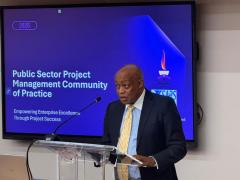
Investing in a corridor once crippled by infrastructural impediments is paying off for Namibia’s Walvis Bay Corridor Group (WBCG), mainly because of sustained demand for copper out of Zambia and the Democratic Republic of Congo (DRC). Speaking at a presentation in Sandton last week, the group’s acting CEO Clive Smith trotted out some impressive volume figures for the hinterland linkages going
north east from Walvis Bay through the Caprivi panhandle to Ndola in Zambia. Whereas the group’s most trafficked corridor used to be the Trans-Kunene directly north to Angola, the WalvisNdola line has become WBCG’s new pulsing lifeline. “Around 2014 we did about 700 000 tonnes of which at least 300 000 were from the Kunene-line. But those volumes have drastically dropped to just 28 000
tonnes in recent times, mainly because of internal issues in Angola.” Thankfully, said Smith, concerted efforts to market a corridor that once presented Namibia’s logistics sector with phenomenal challenges, mainly because of the country’s vast expanses between hubs of infrastructure and economic activity, is bearing fruit and substantially so.Despite the alarming dropoff in freight crossing the Kunene into Angola, WBCG recorded a sharp increase in volumes thanks to increased interest in the Walvis-Ndola line. “In 2018 we went back to volumes achieved in previous years, namely about 700 000 tonnes.” Furthermore, from projections of the group’s
continued efforts to promote the corridor with Zambia, anticipated figures underpin hopes that results will continue to improve. Looked at differently, in 2017 Walvis Bay’s cargo flows between its port and Ndola sat at 47.9%. Currently at 51.8%, that figure is curving up and if harmonisation stoppages with the Kasumbulesa border north to the DRC are sorted out, the
shipment of minerals from the Katanga region is expected to further swell WBCG’s profits from its corridor to the copper belt. At the time this article went to press, Smith was already at the group’s office in Sao Paolo where he was marketing the corridor to investors in Brazil, Namibia’s closest international market.
Pulsing lifeline to Zambia buoys Walvis Bay volumes
Comments | 0
© Now Media. This content is protected by copyright and may not be adapted or republished. If you would like to discuss cooperation opportunities, please contact: editor@freightnews.co.za.