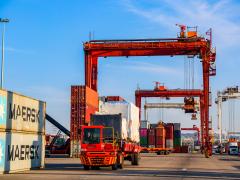
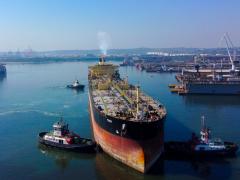
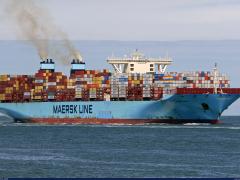
One of the many advantages for FTW readers, advertisers, journalists and sales teams of regularly visiting neighbouring countries is that we are able to identify changing trends in the way people do business and the culture of the society. These trends emerge during the small talk before and after an interview or during dinner. They are also ref lected in the local media and advertising. This year the clear message from Namibia is that “we are proud to be Namibian”. A car parked at a Windhoek logistics company sums it up: “Trots NA”. What says it all is that no-one we mentioned it to thought it was particularly unusual. One got the impression that they were asking themselves “why didn’t I think of that first?” Namibians certainly have much to be proud of. The young country punches well above its weight. Economic growth and social upliftment have their challenges. With a total area of 825 418 square kilometres, it is the 34th largest country in the world. But, with only around 2.2m people, it ranks 143 out of 238 in terms of population density. This puts it 229 out of 238 in terms of population density. To put this in context, South Africa is 166th on this list and has three metros with more than 2.2 million people – Johannesburg, Ekurhuleni and Cape Town. The challenge for the Namibian government is that economic development outside of mining and certain forms of intensive agriculture is usually built on the foundation of a home market. Two million people in a world population of seven billion is 0.02% of the market in a global economy. The Namibian government’s answer to the challenge is to think outside the box – or, more accurately, outside the borders. Its Southern African Development Community (SADC) neighbours add another 277 million people to the home market. And this is where logistics – a fundamental building block for economic and social advancement – comes in. Massive investment in the port of Walvis Bay and the development of the Walvis Bay corridors through a public private partnership have opened up the markets. In addition, the Namibian government has ensured that the country is well represented within the various international trade and economic networks. It is a member of: • United Nations • African Union • Commonwealth of Nations • Southern African Development Community • Southern African Customs Union (Sacu) • Common Monetary Area • World Trade Organization • World Intellectual Property Organization (Wipo) • African Regional Intellectual Property Organization (Aripo) The country is also a signatory of the European Union Economic Partnership agreement with SADC states. Companies along the entire logistics chain have responded by investing in warehousing, trucks, handling equipment and training. Young, ambitious, qualified and energetic Namibians have returned to the country after studying in South Africa and elsewhere and are helping to ensure that the country’s vision of being the logistics gateway for SADC countries is realised. Namibia is an attractive destination for international companies because the Foreign Investment Act of 1990 provides guarantees against nationalisation, provides the freedom to remit capital and profits, currency convertibility and details a process for settling disputes equitably. But, there are conditions – the government wants companies to employ Namibians first, and the Namibian business community prefers to deal with companies that are either proud to be Namibian or proud to be in Namibia. They must be there to make a difference and not just profits. CAPTION The capital city of Windhoek is seen as the econmic hub of the country. CAPTION Showing its pride … a car parked at a logistics centre in Windhoek.
Proud to be Namibian
Comments | 0
© Now Media. This content is protected by copyright and may not be adapted or republished. If you would like to discuss cooperation opportunities, please contact: editor@freightnews.co.za.