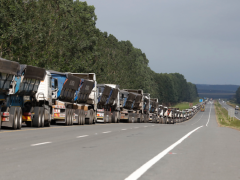
Ongoing strikes have taken their toll on the airfreight industry with export volumes down compared to last year. According to Mike Todd, VP Africa for Air Menzies International SA, volumes for the first six months of this year have declined by at least 5% compared to the same period last year. “The biggest contributor to the drop in volumes has been the strikes,” he told FTW. “The protracted strikes saw lower production levels while some businesses were unable to move their export stock out of their warehouses due to the intimidation of hauliers.” Economists have warned of the detrimental effect of the strikes on the country’s economy. Not only do they discourage foreign investment, they also significantly dent export earnings – the impact of which is felt across the supply chain. According to Todd the airfreight industry was particularly hard hit, and with predictions of South African GDP growth being only in the region of 1.7% this year, there is very little chance of gaining lost ground. “It is very unlikely that we will improve on 2013 volumes in the second half of the year,” he said. “It also seems that airfreight rates are set to continue on their downward trend in this economic climate.” With an over-supply of service providers all chasing a reducing cargo pot it has become an extremely competitive environment. “It becomes questionable whether airlines should be happy about the distribution of International Air Transport Association (Iata) statistics showing volumes and rates of its agents as it makes the environment even more competitive,” said Todd. “While it is interesting marketing information, it also opens the door for the competition, adding pressure to the already downward rate spiral.” Todd also questions the practice of sending out monthly or quarterly specials as an attempt to attract more cargo. “Generally those specials are countered by opposition airlines and the end result is a dilution of yield on the business you were carrying anyway. We know that airlines servicing the South African route are firstly attracted due to passenger volumes and secondly by import traffic,” he said. “The positive spin-off is that South African exports are benefiting from relatively low subsidised freight rates as a result of passenger and import cargo demand and the freight price war.” INSERT & CAPTION With an over-supply of service providers all chasing a reducing cargo pot it has become an extremely competitive environment. – Mike Todd
Protracted strikes leave their mark
Comments | 0
© Now Media. This content is protected by copyright and may not be adapted or republished. If you would like to discuss cooperation opportunities, please contact: editor@freightnews.co.za.