Despite a tough
business climate
in the SADC
region, some
economies are still managing
to maintain steady trade
flows according to a major
transporter in the region.
Robbie Forbes, CEO at
Transit Freight Forwarders,
which was recently bought
by Hong Kong-based
Frontier Services Group and
offers transport services
across the continent,
said trade was currently
“extremely tough” across
SADC from Mozambique,
Zimbabwe and Zambia to
Angola, which are struggling
due to lower global
commodity, mineral and
oil prices. Transit Freight
moves between 8000 and
9000 tonnes of goods,
mainly foodstuffs and bulk
cargo, in the SADC region
every month.
“There is no money
available and economies are
not performing. Some of
the banks are asking their
clientele for extension for
paying out (L/C) credit.
It is extremely tough for
everybody, and everybody
just has to buckle down,”
he said.
Forbes added that
businesses had also been
seriously financially
impacted by Zimbabwe’s
recent import restrictions
and the company had
approximately 20-30
consignments on both sides
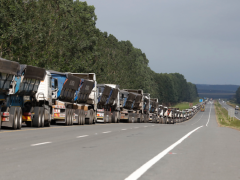
of the Beitbridge border post
when the government made
the initial announcement.
He said the consignments
had stood for 12-14 days
awaiting the subsequently
required import licensing
and some of the cargo had to
be returned to
South Africa
to minimise
costs.
However,
he added that
Namibia and
Botswana’s
import
and export
volumes had
remained
steady year
on year, while
Mozambique
trade was expected to
improve once the natural gas
pipeline from Rovuma Basin
to Gauteng came online in
about six months.
Zimbabwean agricultural
exports to SA of cash crops
like manage tout, flowers
and avocados had improved,
although its global citrus
exports through
South African
ports had
not grown
and exports
remained
mainly
limited from
the southern
Zimbabwean
production
areas.
Forbes
said a major
challenge of
doing business in the SADC
region was the consistent
statutory introduction of
additional product related
compliances destined for and
through Zimbabwe, such as
the pre-export inspection of
basic staple foods from SA to
Zimbabwe which was clearly
aimed at restricting imports
and limiting smuggling
opportunities. This resulted
in considerable cost in delays
for hauliers at ports of entry,
and direct costs for importers
where pre-inspection costs
ranged from US$250-450
per consignment, he said.
“It is taking freight
forwarding costs to another
level.”
Forbes added that there was
a need for SADC countries to
accept that their neighbours
could perform independently
to maintain quality and safety
standards and to reduce
import tariffs on goods that
were not locally produced.
INSERT
Namibia and
Botswana’s import
and export volumes
have remained steady
year on year.
– Robbie Forbes
Product-related compliance stymies SADC growth
Comments | 0
© Now Media. This content is protected by copyright and may not be adapted or republished. If you would like to discuss cooperation opportunities, please contact: editor@freightnews.co.za.