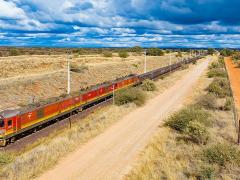
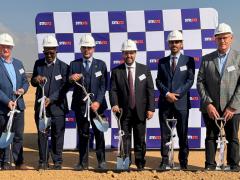
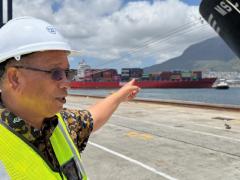
“Not if but when” has long been the thinking at Swaziland Railway concerning extension of the nation’s rail line infrastructure. When the country’s inoperative iron ore mine was open for salvaging mining tailings last year, speculation in Swaziland centred around the concomitant reopening of the rail system’s original line to Ngwenya. However, in his last interview with FTW as CEO of Swaziland Railway, Gideon Mahlalela said: “There are 700 million tonnes for iron ore at Ngwenya, but no company has been granted a licence. We cannot just build the line. We want to see a licence and (mining company’s) backing.” Excavating all that iron ore would be a multi-year project and make the revival of the old Ngwenya line worthwhile. By contrast, current operations to take out decades-old iron ore tailings will be concluded in five or six years. That’s not worth the investment in rail line upgrade. The ore tailings are being trucked to eastern Swaziland and transferred to rail cars en route to Maputo. Swaziland’s rail system carries goods, not passengers, and Mahlalela said little cargo originated locally. The rail company realises its profits through transit traffic from SA. Nevertheless, promoters of rail transport in parliament and the private sector saw the expansion of the rail infrastructure as vital to Swaziland’s economic expansion. The Ngwenya line, along with some infrastructure extension on the SA side, were long seen as a “missing link” that if filled would enable direct rail traffic from Gauteng to Maputo via Swaziland, cutting hundreds of kilometres off a trip currently made on other lines. Hoped for expansion did arrive in January, when Transnet Freight Rail and Swaziland Railway announced the Swazilink initiative: a 146-km line originating in Lothair, Mpumalanga and terminating at Swaziland Railway’s Sidvokodvo Junction. The core line is budgeted at R7.3m. R8.6m will be spent on 600 km of connecting rail lines on the SA side. SA’s government is putting up R12m, while Swaziland Railways is seeking a PPP arrangement. If funding is obtained, the first General Electric locomotives are scheduled to start transporting coal along the line in 2015 or 2016, significantly advancing rail transport in Swaziland. “I’ve been working for years on this project,” said Mahlalela, a long-serving president of the Southern Africa Railway Association. He can now retire with a sense of mission accomplished.
Positive outlook for expansion of Swazi rail line
Comments | 0
© Now Media. This content is protected by copyright and may not be adapted or republished. If you would like to discuss cooperation opportunities, please contact: editor@freightnews.co.za.