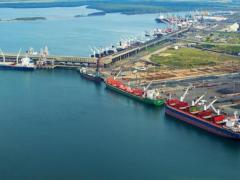
Ongoing upgrades will ensure the Port of Maputo is ready to handle the expected growth in volumes of mineral exports, said Dr Osorio Lucas, CEO of the Maputo Port Development Company (MPDC). While there has already been major investment in the port in recent years, far-reaching plans to deepen the channel as well as strengthen and deepen berths are in the pipeline. “The planned investment in the port from now to 2030 is some $1.7 billion,” said Dr Lucas. “The first phase of construction on the channel deepening and the work on the berths is expected to start early next year.” He said a short-term investment of about $355 million had been set aside for the next five years and would help the port achieve its long-term goal – to be one of southern Africa’s top mineral exporters. “The container terminal and bulk handling facilities will also be expanded to give us the extra capacity that we will need.” According to Dr Lucas, some $834 million will be spent on the coal terminal, another $300 million on the container terminal and a sum of $104 million on the bulk terminal. “The dredging of the channel to 14 metres will cost about $47 million while a further $247 million will be used to upgrade the road and rail infrastructure within the port.” While the Maputo Port has consistently seen an increase in containerised cargo over the past few years, it remains predominantly a bulk port shipping out various metals and minerals. Ferrochrome and chrome ore from Zimbabwe and South Africa, magnetite from Phalaborwa in South Africa, coal from South Africa and more recently Botswana and iron ore from Swaziland make up the bulk of the minerals shipped from the port. “Looking at the increase in the minerals we handle it is clear that rail is an important part of our long-term vision as it is the most efficient way to move these commodities. At the same time our berth utilisation at present is very high and they are old,” he said. “The only feasible way we can address these challenges is by investing in new infrastructure. That means building new berths and also increasing the capacity of our current berths.” CAPTION Dr Osorio Lucas … ‘The planned investment from now to 2030 is some $1.7 billion.’
Port of Maputo aims to become bulk port ‘king’
Comments | 0
© Now Media. This content is protected by copyright and may not be adapted or republished. If you would like to discuss cooperation opportunities, please contact: editor@freightnews.co.za.