An innovative strategy to divert
perishable cargo from Durban
to the country’s Western and
Eastern Cape ports could be
the catalyst for a significant
modal shift from road to rail
transport.
Citrus Growers’ Association
of Southern Africa (CGA SA)
logistics development manager,
Mitchell Brooke, told delegates
at a business breakfast on
Transnet Freight Rail’s road to
rail strategy hosted by FTW
and the JCCI recently that the
Durban Container Terminal
was over-utilised compared to
other ports and terminals in
South Africa.
“There is huge scope
for Transnet in the fruit
sector, with around 35 000
containers/R400 million in
additional revenue at stake,”
he said, “and South Africa
needs to create a fully utilised,
bi-directional intermodal
reefer hub-to-hub service for all
refrigerated commodities.”
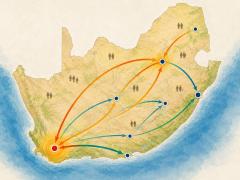
Brooke said South Africa
had a different set of logistics
parameters between the
northern and southern areas
of the country and needed to
look at implementing hubs
in Kakamas, Polokwane,
Johannesburg, Pretoria, and
in the Ceres and Sundays River
areas, where hubs based on
SEZ policies could attract more
perishable product onto
trains.
He explained that
a shift to the Cape provinces
could save seven days of transit
time, as vessels that called on
Durban also called on Port
Elizabeth and Cape Town
before leaving for Europe.
Similarly, one could save seven
days by using rail from Cape
Town to Gauteng, instead
of going to Durban before
trucking goods up the N3.
Containers that were not
plugged in were sitting outside
the Durban container terminal
for long periods of time, which
caused massive cold chain
quality issues and many were
aware of the issues with getting
containers out of the country’s
busiest port, he said.
Brooke pointed out that
two ships left Cape Town
every week for Europe. From
there, the fruit industry could
penetrate the entire European
market as well as Scandinavia
and Russia by using the vessels.
A substantial number of
refrigerated containers
came into the country’s
ports too, which were
being de-stuffed in Durban
and Cape Town before
refrigerated trucks moved them
to Gauteng and other inland
areas.
“Those containers should
come back onto the train and
be moved to inland areas for
de-stuffing. The containers
could then be
available to
move export
commodities
out from the
inland areas
back to the
ports,” he added.
Current
costing in the
fruit industry
is based
on moving
containers in
one direction.
“We are
bringing empty
containers up
from the ports
to pack inland and returning
them to port which means
the cost is recovered on fruit
exports for both directions.
We’ve got to look at a trade-off
and bring other commodities
into the picture,” he said.
Fruit South Africa’s rail
transport strategy has
been developed to create a
sustainable and efficient
transport link, which
considers that the country
has had to develop a costeffective
and efficient
means of
transporting
perishable
goods from
place of
production
to place of
consumption.
“We’ve
got to see
a proper
pricing policy
to support
the industry,
maybe over
a five-year
period, to
drag fruit back onto rail.
We also need to have the
infrastructure in place, in
the right areas, to capture
the markets and the entire
region’s fruit production,”
he said.
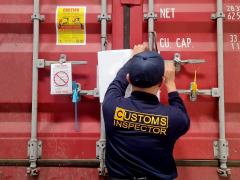
INSERT AND CAPTION
A shift to the Cape
provinces could save
seven days of transit
time as vessels that
call on Durban also
call on PE and Cape
Town before leaving
for Europe.
– Mitchell Brooke
Perishable industry proposes hub strategy to grow rail business
Comments | 0
© Now Media. This content is protected by copyright and may not be adapted or republished. If you would like to discuss cooperation opportunities, please contact: editor@freightnews.co.za.