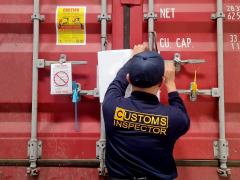
South African citrus
growers have voiced their
concern over the European
Commission’s (EC) pending
legislation with regard to
false codling moth (FCM)
on citrus.
The European
Parliament in December
voted in favour of a
resolution calling on the
Commission to introduce
stricter measures on
citrus imports and it will,
if accepted, affect South
African citrus exports
significantly.
The
legislation
will also
see stricter
measures
imposed for
Citrus Black
Spot (CBS).
South
Africa has
in the past
10 years
shown its
commitment
to meeting
EC
regulations
and demands with regard
to CBS even though
scientific research has
proven that CBS fruit from
South Africa cannot infect
European crops.
According to Deon
Joubert, Citrus Growers'
Association (CGA) special
envoy: market access and
European Union (EU)
matters, there is much
concern over the new
developments.
“The pending legislation
– especially in terms
of FCM – is seemingly
discriminatory against
citrus since citrus is not
even one of the biggest
sources of interceptions
regarding FCM in Europe
annually,” he told FTW.
He said in addition to the
regulations already in place
the EC wanted to delete the
derogation for citrus fruit
processing with regard to
CBS, and to
introduce a
regulation for
the first time
on FCM.
“The
measures
suggested
to combat
FCM do not
seem to be
applicable to
all the sources
of FCM
interceptions
but are
specifically
geared
towards citrus,” said
Joubert. “We have to ask
when one looks at the
suggested measures they
want to impose – what
is the real risk of FCM?
We are not exporting
propagation material
which makes the regulation
measurements seem
excessive.”
He said the measure of
regulation needed to be
consistent with the risk
posed.
South African citrus
in 2016 saw less than ten
cases of FCM intercepted.
Hardly comparable with
the more than 77 to
87 cases intercepted
from other countries
in Africa on other
products like
capsicum and
f lowers.
“One has to
question why citrus is
being targeted,” he said.
The new regulations
will see compulsory cold
treatment imposed on all
citrus imported into the
EU.
South African citrus
exporters have said the
call for compulsory cold
treatment does not seem
consistent with the small
risk posed. They are hoping
that the eventual EC vote
on the new legislation –
member states at the time
of going to press remained
in debate on the issue – will
be balanced and reasonable
while addressing the FCM
risk evenly on all imported
products.
“Cold-sterilisation
has been around for 30
years and is considered
old technology,” said
Joubert. “There are far
more effective measures
to apply to give one the
same level of protection or
risk mitigation. Cold steri
treatments are applied
after the fruit has been
infected. The modern
treatments available from
the CRI’s impressive
research programmes
are environmentally
friendly, highly effective
prior to fruit infestation
[proactive] and reduce
FCM at source.”
As an example, South
Africa in its attempts to
mitigate CBS has seen
the introduction of the
latest and best proactive
technologies. This saw
only four cases of CBS
intercepted in the country
last year – considerably
fewer than the more than 80
cases some ten years ago.
“Whether it’s CBS or
FCM, as an industry we
have proactive methods
in place that are green and
highly effective. Our industry
has worked extremely hard
to comply with the EU
regulations and in doing
so we have introduced
technologies and approaches
that are working.”
He said it would be
unreasonable for the
commission to enforce
draconian measures such as
those being contemplated on
one particular industry.
The measures are foreseen
to come into force in 2018
if the EC accepts the new
regulations shortly.
Joubert said it was still
too early to say what South
Africa’s course of action
would be should the EC
vote in favour of stricter
measures.
INSERT AND CAPTION
The pending
legislation ―
especially in terms
of false codling
moth ― is seemingly
discriminatory against
citrus.
– Deon Joubert
Pending new legislation raises concern for citrus exporters
Comments | 0
© Now Media. This content is protected by copyright and may not be adapted or republished. If you would like to discuss cooperation opportunities, please contact: editor@freightnews.co.za.