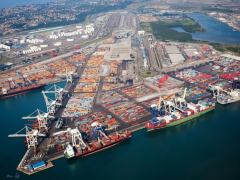
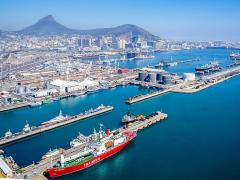
A partnership project between Transnet and Maersk in Cape Town achieved a 25% reduction in port stay time for vessels, according to Nishen Reddy, head of terminal partnering, Africa liner operations cluster, with Maersk, South Africa. Evidence, in his view, that overcoming capacity and efficiency constraints at Africa’s ports is all about partnership between shipping lines and terminal operators to rid the system of inefficiencies. “Operational efficiency gains represent value for both the shipping line and the terminal,” said Reddy. “For us as a shipping line an increase in productivity means a faster turnaround time of vessels which allows us to offer a more reliable product while resulting in massive bunker savings.” For the terminal operator operational efficiency means immediate increased capacity. Reddy said the Cape Town project had revealed that operational efficiency could be ramped up by at least 40% through a partnering programme. “No longer is the shipping line the bully calling for faster turnaround time in the port, but rather working with the terminal operator to find solutions. Through the projects that we have done we have seen increased customer satisfaction as well as improved resource efficiency and immediate capacity increases.” He said claims that ports in Africa were not capable of doing 6000 moves in 24 hours which equals berth productivity of 250 plus moves per hour were not necessarily true. “Granted we are not there yet and much work still has to be done, but during our partnering project with Transnet at the Port of Durban we managed to achieve 140 work moves an hour, proving that we can overcome the constraints we face and that we are getting there,” he said. Reddy maintains that despite being limited in terms of equipment there was an overall steady increase in the gross moves per hour at terminals, especially in South Africa. “Shipping lines account for at least one third of all delays to ports and the reality is that as vessel sizes have increased, berth productivity has fallen behind. Lines expect ports to be productive and move them through the system as quickly as possible.” According to Reddy, Maersk first conceptualised the terminal partnering concept in 2010 and while it involves plenty of calculation and statistics, it effectively means a joint effort from both terminal and shipping line to rid the system of inefficiency. “Now that can mean anything from not waiting for the pilot to arrive on the vessel to bring it into the harbour, to having immigration waiting and ready on the quayside, to planning shift changes better to not affect loading or unloading. These are all cost-neutral interventions that ultimately reduce the time the vessel is in the port – which is the ultimate objective.” CAPTION Nishen Reddy … steady increase in the gross moves per hour at terminals.
Partnership project achieves 25% reduction in port stay for carrier
Comments | 0
© Now Media. This content is protected by copyright and may not be adapted or republished. If you would like to discuss cooperation opportunities, please contact: editor@freightnews.co.za.