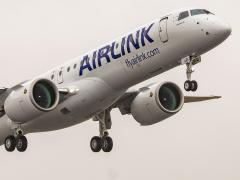
The launch by Safair of a new low-cost carrier, FlySafair, on the Johannesburg-Cape Town route – currently dominated by the national carrier and Comair – will add options for the freight industry. But according to parent company Safair’s vice-president commercial, Neville Desselss, the take-off date for the new service – to be operated by a Boeing 737-400 – is still up in the air, and available cargo capacity is as yet undecided. “At this stage,” he told FTW, “we are still investigating the cargo option.” While the industry has welcomed the possible additional capacity along with all the cost-related benefits of competition, the launch of the new service has been overshadowed by an intriguing debate about who-owns-what. An argument is currently taking place between airlines Comair and Safair, in which the ownership of FlySafair – and, in turn, of parent Safair – is being disputed. Comair’s point is that the airline ownership exceeds the permissible 25% stockholding allowed to be held by a foreign owner, and it should therefore not have been granted a licence by the SA Air Service Licensing Council. Comair CEO Erik Venter said the company had raised its objections to the licensing council in July when Safair applied for a scheduled passenger service licence under the name FlySafair. But the council rejected Comair’s complaint and granted the licence for FlySafair to operate up to ten daily flights between Johannesburg and Cape Town – using two Boeing 737-400 aircraft. Safair CEO, Dave Andrew, said that 75 % of the company was controlled by three directors, himself, chairman Hugh Flynn, and chief financial officer Elmar Conradie. But Comair intends to make an objection to the licensing council over the granting of the licence and, if necessary, apply for an interdict to stop FlySafair from taking off. It has tabled two objections to the licensing council. The objections are based on Flynn’s dual citizenship. According to Venter and Comair’s head of regulatory affairs, Kim Gorringe, Flynn resides permanently in Ireland and visits SA occasionally. In addition, Gorringe said Safair was actually a front and wholly owned by the ALS Aviation Group. Now this is where everything becomes a bit cloudy. That who-owns-what question is not easy to answer – possibly apart from the fact that Safair said it owned FlySafair. But who owns the Safair group? FTW did some extensive digging, and came up with the following history of Safair from 2007. At that time, it was owned by the Imperial Group. But in late 2007 Imperial decided to dispose of all its aviationrelated businesses. Included in these were Safair Lease Finance and Safair Operations, which were sold along with other assets of the Imperial Aviation division to “various subsidiaries of Aergo Capital Limited, an aircraft leasing company based in Ireland”, according to an official notice at the time from Imperial. Hubert Brody, CEO of Imperial Holdings, now confirmed to FTW that his group had indeed sold these to Aergro, lock, stock but not quite barrel. What remained were a fleet of nine Hercules aircraft, which were to be leased by Aergo for a maximum period of five years, and three MD 80 series aircraft and two Boeing 737-200 aircraft, which were running out their existing lease contracts and were to be disposed of thereafter. The deal for the acquisition of the SA aircraft leasing and operating company Safair was stated by Aergo as finalised in December 2008. Then in September 2010, the Irish Times reported that Aergo Capital had sold its interest in Johannesburgbased subsidiary Safair to Dublin-based listed company, ASL Aviation. The deal involved Aergo selling its interest in Safair Operations, Safair Lease Finance and three ATR72- 500 aircraft. The deal was concluded by November. In talking about whoowned- what earlier, we used the terms “cloudy” to describe the difficulty in finding what to believe. But now, it’s a positive thunderstorm. ASL’s web page, talking about the history of the group, came up with a rather startling statement. “In 2007,” it said, “Imperial disposed of all its aviationrelated businesses – which were acquired by CMB and 3P Airfreighters.” Now the ASL group has two shareholders – Compagnie Maritime Belge (CMB), a major Belgian shipping company based in Antwerp, with a 51% shareholding; and 3P Air Freighters, an aircraft leasing company incorporated in Dublin, with 49%. But it then said – “Acquisition of the Safair Group was finalised in late 2010, which includes the leasing and airline operations, based in SA” – which at least complies with the date of that supposed acquisition from Aergro. And it certainly clearly states that it still owns Safair. ASL also lists Safair and its activities for the year in its 2012 annual report – so it seems to have no doubts about the fact that it owns Safair. But Andrew said Safair was not a subsidiary of ASL, but rather an associate company. Although it is not stated in any of the Aergro or ASL documentation available to FTW, it would seem that Andrew’s case is that the three South Africans acquired their 75% stakeholding after the takeover of Safair by Irelandbased Aergo Capital in 2008 from Imperial Holdings. “I believe that it is….pertinent to reiterate that Safair has had a 75% South African shareholding since 2009,” said Andrew. It would then appear that Aergo sold its remaining 25% stake to ASL in 2010. That is possibly why Comair’s other objection is about Flynn’s residence. In Section 16 (4) (c) (ii) and (d) of the Air Services Licensing Act No 115 of 1990, any applicant for a Type S1 To Class 1 Air Service Licence needs to have at least 75% of its voting rights held by SA residents. The latest arguments venture off into the implications of “dual citizenship” and the frequency of Flynn’s visits to SA. But it’s all too murky and contradictory for FTW to reach a conclusion. Rather we and our readers must wait till the licensing council, or possibly a court, comes up with a decision on: Who owns what, and who lives where? INSERT & CAPTION Comair raised its objections to the licensing council in July when Safair applied for a scheduled passenger service licence under the name FlySafair. – Erik Venter
Ownership squabble overshadows launch of FlySafair
Comments | 0
© Now Media. This content is protected by copyright and may not be adapted or republished. If you would like to discuss cooperation opportunities, please contact: editor@freightnews.co.za.