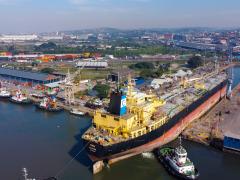
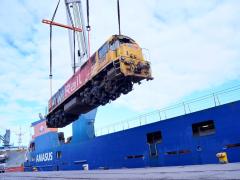
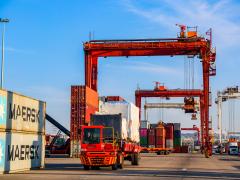
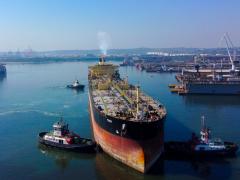
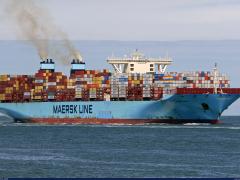
The Ngqura Container Terminal (NCT) has increased its fleet of shipto- shore cranes by two with the arrival of new Liebherr gantries as part of a R1.1-billion infrastructure investment in the Ngqura Container Terminal. The two ship-to-shore (STS) cranes will bring the full crane contingent at NCT to 10. “The strategic objective of Phase 2A is to create additional capacity to position NCT as a transhipment facility, supporting Transnet’s Market Demand Strategy. This investment will further stimulate economic development creating much needed jobs in the Eastern Cape,” says Siya Mhlaluka, general manager, Eastern Cape. Phase 1 of the Ngqura NCT saw the development of a four-berth terminal capable of handling 800 000 TEUs a year. Initially, Phase 2 was intended to deliver a 2 000 000-TEU four-berth terminal. However, slow global economic growth led to lower volume projections and this phase has been split into Phase 2A and Phase 2B, he says. Phase 2A will increase the terminal’s capacity from 800 000 to 1 500 000 TEUs. This is in line with demand projections. The increased capacity will enable the terminal to improve efficiencies via faster vessel turnaround times and reduce berth occupancy to below 65%. The new cranes have arrived as fully knocked down units which will be assembled at Ngqura Container Terminal, with commissioning scheduled for June 2014. The new STS cranes are larger than any of the existing cranes at NCT, being approximately three metres higher. They have an outreach of 24 containers, or 65 metres, and are optimised to deal with the new generation of 18 000-TEU container vessels. Port-side support was increased with the arrival of 18 Liebherr Rubber Tyred Gantries (RTGs) in February this year. The new RTGs can stack up to five containers high. Each RTG comes with a list of features including DGPS, auto steering and container location recognition systems. They are capable of operating in wind speeds of up to 80km/hr. Each RTG will be fitted with an ultrasonic anti-collision system. Cameras will monitor travel in both directions, with a direct feed sent to monitors in the driver’s cabin. They are the first of their kind to be supplied to Transnet Port Terminals, according to Mhlaluka.
Ngqura takes delivery of two more crances
Comments | 0
© Now Media. This content is protected by copyright and may not be adapted or republished. If you would like to discuss cooperation opportunities, please contact: editor@freightnews.co.za.