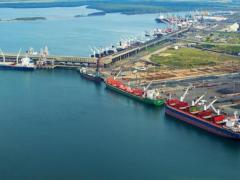
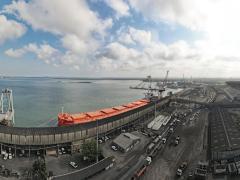
Dreaming the impossible dream. That describes Transnet’s aspirations about the future potential at the new deepwater port of Ngqura in the Eastern Cape, according to Salvatore Sarno, chairman of MSC – the first line to allot commercial containership calls to the port. Transnet’s high hopes about Ngqura becoming a multi-million container hub port are no more than a dream, he told FTW. “We have accepted to help Transnet develop this new port,” he added. “And I had some of their representatives in Geneva, Switzerland, some weeks ago to meet our president, Gianluigi Aponte, who explained to them that Ngqura could not be a major hub, no matter what they think. “You can do some transhipment there, but not up to the big dream of Transnet.” Ngqura’s location is just all wrong. According to Sarno, in the worldwide container market, the generator that drives the numbers of containers in any region of the globe is the number of consumers it contains. If you look at the eastwest trade belt in the northern hemisphere – stretching from China and the rest of Asia, through Europe to the US – you have many hundreds of millions of consumers, and therefore millions of containers. But in the southern hemisphere belt of South America Africa and Australasia, you maybe have 200 million true consumers “at the very most”, Sarno suggested. There is, therefore, only limited reason for any northsouth traffic flows given such a global pattern. “So this route (via SA and the Port of Ngqura) cannot act as the transit for these millions of containers through the northern hemisphere,” he added. “And so it can’t be a major hub.” Sarno certainly doesn’t raise an outright rejection of the port having a significant (in African terms) transhipment function. “We are optimistic that the port will develop itself,” he said. “You’re maybe talking 100 000 to 200 000 transhipment boxes a year. But not the millions they (Transnet) think.” And it’s not that MSC is going to avoid the port. It has already allocated calls for one of the vessels in its SA-Europe service, with Ngqura substituting for previous calls in Port Elizabeth. “This,” said Sarno, “shows our goodwill, and that we are co-operating in helping to develop this port.” He saw this as MSC’s way of saying thank you to the SA market and port authorities for their support over the line’s 20-year history – in which SA was the major initial player in its expansion into the global giant that it is today. It is now ranked second largest container line in the world, according to AXS Alphaliner’s ratings, with a carrying capacity of 1 507 836-TEUs and an 11.1% market share, second only to the Danish line APMMaersk with it 14.9% slice of the market. “We don’t forget that we’ve created a firstclass shipping line in this country,” Sarno said, “and we must pay this country back.” MSC is certainly not calling at the new Ngqura port with any big moneymaking intentions. Apart from offering the line’s help in developing the port, Sarno added: “I see no other advantages for the time being.”
‘Ngqura has limited hub potential’
Comments | 0
© Now Media. This content is protected by copyright and may not be adapted or republished. If you would like to discuss cooperation opportunities, please contact: editor@freightnews.co.za.