Following “major delays
and total border chaos”,
the Federation of East and
Southern African Road
Transport Associations
(Fesarta) is engaging with
the Southern African
Development Community
(SADC) to “insist on a
review” of the procedure
by Zimbabwe Revenue
Authority (Zimra) to
implement new transit
cargo regulations.
Last month Zimra
implemented its new
Statutory Instrument
(SI) 113 to “improve the
management of transit
cargo”, according to a
statement by the revenue
authority. The new
legislative amendment – to
Section 60 of the Customs
and Excise Regulations
– requires that “all road
vehicles conveying goods
through Zimbabwe shall
have electronic seals placed
on their cargo” at port of
entry at a cost of US$30.
The seals are reportedly
to be paid for by
transporters in US dollars
and vehicles transporting
bulk cargo and the like
which cannot be sealed are
to be escorted in convoys,
organised by the Zimra
commissioner. A transport
operator, who spoke to
FTW on condition of
anonymity, said this was
causing delays of up to five
days.
“The costs of the seals
and penalties add to
the cost of crossing the
Zimbabwean borders. In
addition, the increased
delays caused by stops
related to the new
regulations are major
barriers to effective trade,”
he said.
Fesarta has lodged a
non-tariff barrier (NTB)
complaint highlighting
that Zimra is not adhering
to the new procedures for
handling transit cargo.
The NTB complaint
reads: “All transit cargo
is being fitted with seals,
despite the cargo already
being sealed by the client at
loading point. Information
from drivers indicates that
currently only five trucks
are being sealed per day.”
According to the
complaint, trucks are then
added to a list for transit
escort. This is despite the
official communication
stipulating that only trucks
carrying cargo that is not
covered by a suitable tent/
tarpaulin that cannot be
sealed will be considered by
authorities to be escorted.
One incident reported to
FTW involved a tautliner
truck – which could easily
have been sealed – where
the driver was told that
his vehicle needed to be
escorted. He was informed
that only five trucks per
day could be escorted to
the Chirundu border post
and he was number 48 on
the list – which meant a
delay of five
days.
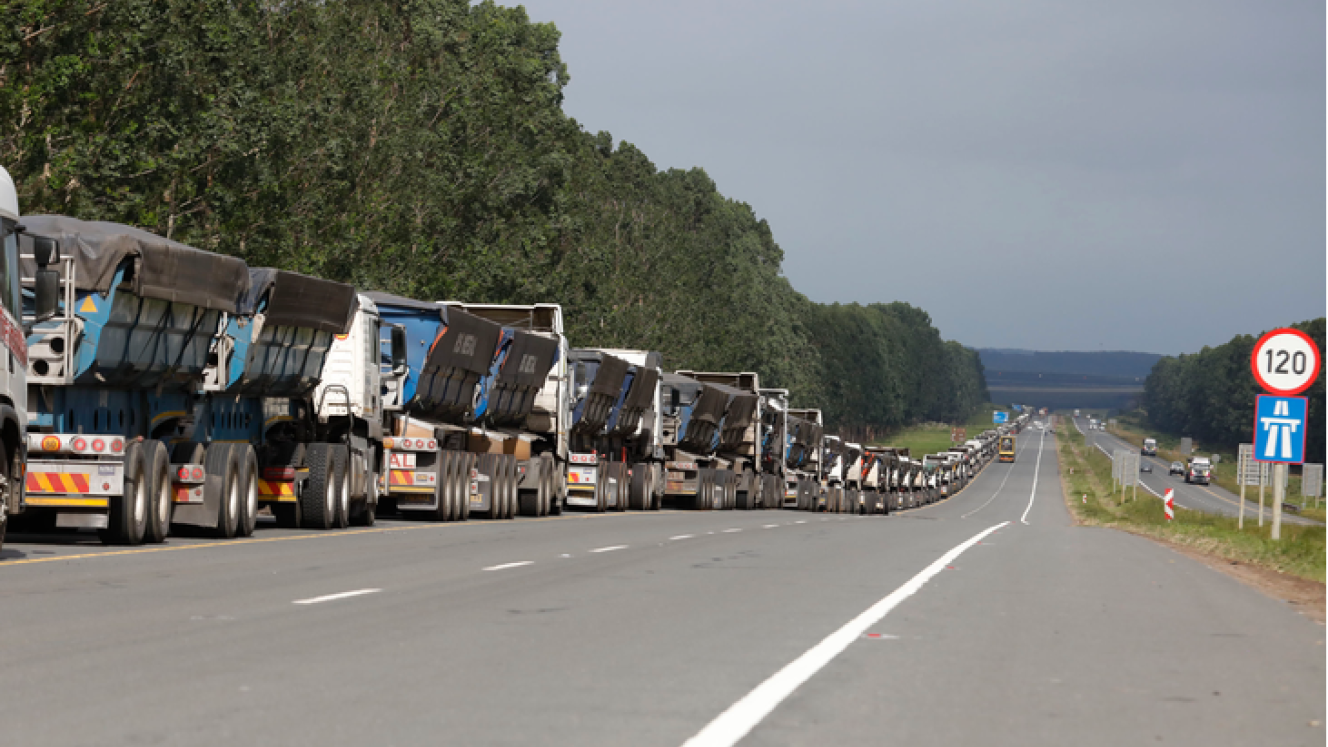
A report on
the Fesarta
website
highlighted
that all
Zimbabwean
borders had
been hit by
chaos and
delays, noting
that that two
weeks ago, at
the Forbes-
Machipanda
border post between
Zimbabwe and
Mozambique, there
had been an up to
10-kilometres-long
queue of vehicles waiting
up to 72 hours to cross
into Zimbabwe – often
including fuel tankers and
fertiliser trucks.
This is a dangerous
cocktail of chemicals
which could cause a
serious accident similar
to the explosion at the
Kasumbalesa border post
three years ago in which
five drivers burnt to death
after drivers had made
a fire to cook a meal. A
leak from a petrol tanker
reached the fire and
caused a massive explosion
affecting over 100 trucks.
Mike Fitzmaurice, CEO
of Fesarta,
said the
congestion
issues had
claimed the
first casualty
about three
weeks ago
when a child
playing
under a fuel
tanker had
been run
over by a
truck when
the 10-kilometre queue had
suddenly started moving.
He said he hoped that
the “regrettable” tragedy
would highlight the dangers
of staging large numbers
of vehicles in uncontrolled
areas with no security
or facilities for extended
periods of time.
Zimra could not be
reached for comment.
INSERT & CAPTION
The costs of the seals
and penalties add to
the cost of crossing
the Zimbabwean
borders.
– Mike Fitzmaurice
New Zim transit regulations cause border chaos
Comments | 0
© Now Media. This content is protected by copyright and may not be adapted or republished. If you would like to discuss cooperation opportunities, please contact: editor@freightnews.co.za.