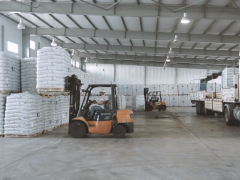
ALAN PEAT SYSTEMS, SYSTEMS. That’s a headline phrase in the words of Arnold Garber, MD of Compu-Clearing, as he gave FTW his views on warehousing. Location, layout and cost of property assets and their management are established, and the more high-tech internal and external handling equipment is advancing in efficiency and sophistication – but at a reasonably leisurely pace given its current high state of development. However, control of all the various operational tools and administrative management of warehousing complexes – from receipt of goods through storage to dispatch – is now crucial, as warehousing operations vie to present the most cost-efficient, controlled environments. This follows the advance in recent years from the days of every importer owning his own offices and warehouse, to the modern-day trend for 3rd party warehousing. This applies both to those who specialise in simple storage for manufacturers, and those who handle this link in the logistics supply chain for imports and exports – and conduct full stock control and distribution for the product makers. Areas where warehouses concentrate on a specific field of manufacture – and store products from numbers of opposition manufacturers – demand particular control, according to Garber. The need for systems is also growing under the influence of the Internet. “The trend here,” said Garber, “is that the use of the Internet encourages smaller transactions – in the business world mostly on a just-in-time basis. “This means that numbers of transactions have expanded rapidly, although volumes stored, and value, remain very close to what they were before.” It’s all about systems, and electronic tools like bar-coding and radio frequency identification (RFID). There have always been good systems around for warehouses, Garber added. “But they were very expensive, only feasible for the larger operators, and smaller businesses had to do without,” he said. “But today, there are lots of warehousing systems which are more basic, and designed for the small operator.”
New systems become more price-competitive
Comments | 0
© Now Media. This content is protected by copyright and may not be adapted or republished. If you would like to discuss cooperation opportunities, please contact: editor@freightnews.co.za.