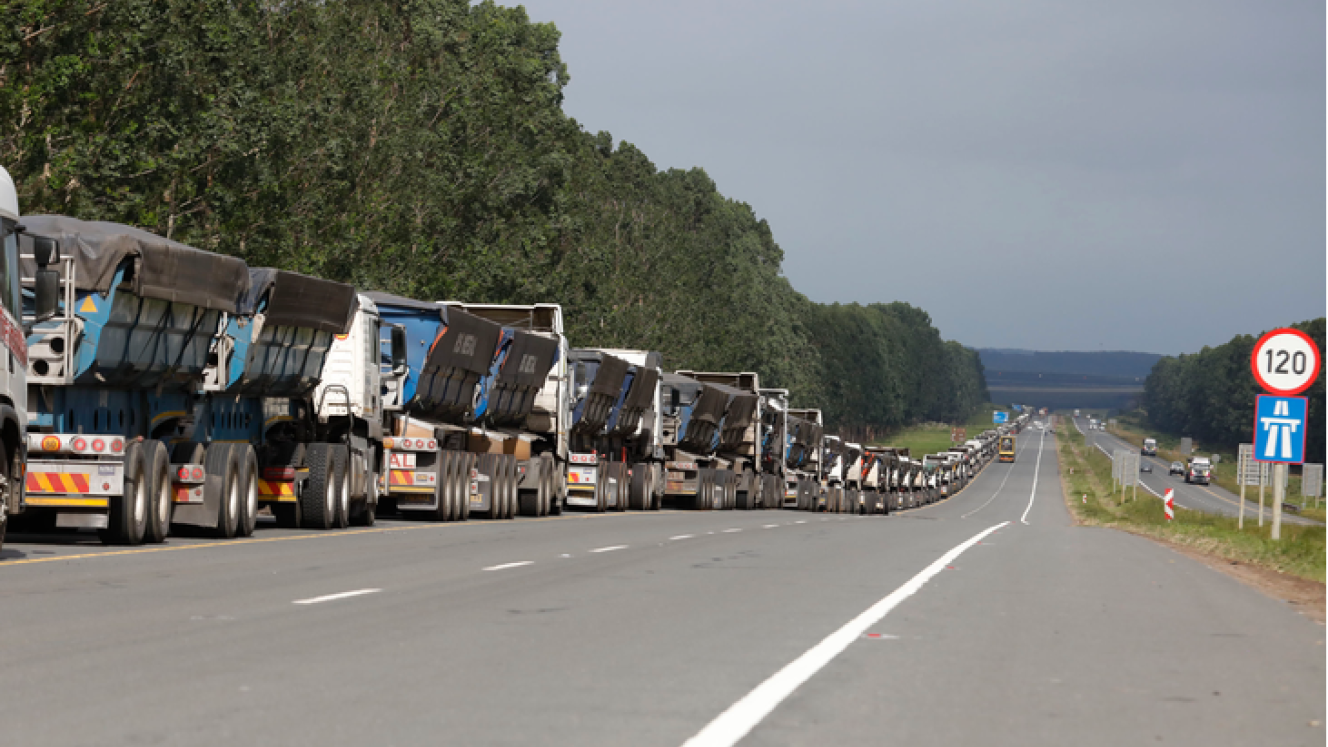
Newly appointed CEO of Swaziland Railway, Stephenson Ngubane, expects rail freight volumes to increase significantly in the immediate future. Ngubane joined Swaziland Railway in 1986 as a trainee mechanical engineer and has moved up the ranks to his current position on a threeyear contract. In his first media interview following his appointment, Ngubane told FTW that for the company year ending March 2013 Swaziland Railway’s profits had grown 40% over the 2011-2012 company year. The rise was due to the transport of iron ore tailings from a mining firm operating in Western Swaziland which trucks the ore to the company’s depot in central Swaziland where it is moved to the port of Maputo. Previously the ore was transported entirely by road. Good weather resulting in a larger sugar crop accounted for more sugar transported in its raw state being moved by rail. This volume rise is expected to be dwarfed once the line connecting Lothair, SA with Swaziland allows cargo from Mpumalanga and Gauteng to travel northward through Swaziland’s rail system. Currently rail lines run east-west. “The line is on schedule, and we are entering Phase 3,” Ngubane said of the project that partners Swaziland Railway with Transnet Freight Rail. “Phase 1 was concept and Phase 2 was the probability study, when we explored four route options. Where we are now, because we’ve selected the route, is the design phase, economic viability studies, land issues, everything that goes into planning. Phase 4 is construction. The line will be operating in 2017,” Ngubane explained. His bicameral vision for the future concerns both Swaziland’s and the region’s rail future. “I am looking at a programme to extend the network to broaden our revenue base at Swaziland Railway. We want to connect all of Swaziland’s sugar mills to rail. We want to ensure that we offer the most economically affordable transport. For bulk transport, rail is more costefficient,” he said. “Regionally, we want to integrate all rail services and expand the rail system. We must provide our customers with similar service for landlocked countries. The regional rail systems will be made compatible. Goods will move from one point to anywhere in the region without interruption,” Ngubane said. Rail’s cost advantage has been achieved by fuel efficiency, and this selling point bears repeating, he feels. “The focal point is unit cost. How much does it cost to move one tonne the distance of one kilometre? Rail is slower than road but long, heavy, slowmoving trains use less fuel than trucks. But you need a quantity of cargo to fill the trains, which is why rail is better for minerals and heavy cargo,” he said. While volumes of the mineral vermiculite transported by Swaziland Rail were small this past year at only 1000 tonnes, 2.8 million tonnes of magnetite was transported and 1.7 million tonnes of phosphate. Originating in Phalaborwa, the minerals represent the type of transit rail traffic passing through Swaziland from SA to Durban, Richards Bay and Maputo that generate the bulk of the company’s profits. The Lothair line will dramatically increase the amount of transit traffic and concomitant company revenues, commencing in four years' time. INSERT & CAPTION We want to connect all if Swaziland's sugar mills to rail. -STEPHENSON NGUBANE
New Swazi Rail CEO upbeat
Comments | 0
© Now Media. This content is protected by copyright and may not be adapted or republished. If you would like to discuss cooperation opportunities, please contact: editor@freightnews.co.za.