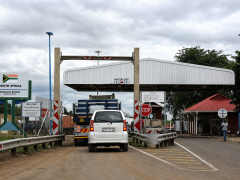
Commercial vehicle guarantees replaced Alan Peat FORWARDING AGENTS at Beit Bridge border post are being hit with big bills from customs - all because of a change in rules instituted by customs, but which they can't control, according to Edward Little, executive director of SAAFF (SA Association of Freight Forwarders). Last December, the association received notification from Patricia Jones, national manager of land, rail & concessions at border control in Pretoria, that customs intended to stop the use of commercial vehicle guarantees (CVGs), controlled by the agents and replace these with customs' own-controlled temporary import permits (TIPs). The CVG scheme had been in place for some years, and allowed agents to monitor the fact that vehicles carrying goods for them into SA had in fact left the country after that delivery. If any vehicle remained in the country - and the agents were hit with a demand from customs for duty and VAT on that vehicle as an import - they were then covered by the guarantee. Said Little: "I appreciated the feelings at customs that the CVGs had no legal standing in terms of the Customs & Excise Act and that the TIP (DA 307) is a legal document laid down in Schedule No. 4 to the Act. "SAAFF, however, questioned the practicality of a document signed by a driver of a commercial vehicle who would have no authority to bind his company, and where that company is registered in a foreign country. "Initiating litigation on the strength of such a document might be a little like skating on thin ice." Little also expressed his disappointment that the measure had been introduced "with immediate effect" - without prior consultation with SAAFF or the Road Freight Association (RFA), and without due notice being given. "Also," said Little, "proceeding against a driver because he has signed the TIP might not be very productive. It would be the management of the company that owns the vehicle that determines what is to happen with that vehicle and not the driver." Meetings immediately took place at Beit Bridge between the local association and customs - during which SAAFF was told that customs were going to outsource the control of the TIPs (both tourist and commercial). A meeting with Jones was also arranged and subsequently held in Pretoria, but without Jones being present. "It was also subsequently pointed out to the customs controller in Beit Bridge," said Little, "that the Zimbabwean customs authorities in particular, but many others as well, found it necessary to retain the use of the CVGs. "Despite having expressed all of our misgivings, customs nevertheless went ahead and implemented the terms of Patricia Jones' letter." But, Little added, it would now seem that the necessary controls were either not put in place, or were inadequate. "Customs," he said, "are now demanding that the agents take responsibility for all of the vehicles that entered the country and which customs are unable to prove exited within the permitted period. "As the clearing agents - on customs' instructions - discontinued the use of the CVGs, they no longer have the bonds in place on which to fall back." Customs officials have now "scheduled" a number of agents in Beit Bridge, under pain of not having their licences renewed. Just three of the amounts demanded are bills for R1.9-million, R3-m, and R8-m.
New Customs permit rule hits agents with big bills
Comments | 0
© Now Media. This content is protected by copyright and may not be adapted or republished. If you would like to discuss cooperation opportunities, please contact: editor@freightnews.co.za.