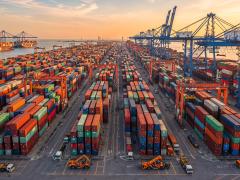
Alan Peat and Joy Orlek The Customs Bill skidded off the political racetrack three years ago – but it’s now back, racing on the last lap towards the chequered flag. Or at least that’s the gist of what Malcolm Hartwell, master mariner and director of international lawyers Norton Rose Fulbright, told FTW. “The SA Revenue Service (Sars) has advised us that the draft Customs Control Bill and draft Customs Duty Bill (which combine to replace the previous legislation) have been approved by the state law office and have been submitted to cabinet for their approval,” he said. “Unfortunately, until cabinet approves the bills, they have no idea when they will be submitted to parliament for approval. “They do, however, anticipate that the bills will become acts within the next year.” Of course there is a chance that they may be amended before they are enacted, he added. “It really depends on what happens in cabinet and once they get to parliament.” But the downstream implications of amendments to the Customs Control Bill have attracted fierce industry reaction. And while the impact of acquitting cargo at the first port of entry will clearly have serious implications for the freight industry, there are good reasons for Customs’ revamp of the bill. “It’s a complicated piece of legislation to find your way around,” said Andrew Robinson, also a director at Norton Rose Fulbright. “What they have tried to do in the new version is to simplify it so that it flows better.” The revised bill is also an attempt by Sars to stamp out customs fraud by importers who have all sorts of schemes involving delayed payment of duties – often for cash flow purposes. “Under the current regime, an importer in Johannesburg can bring cargo through Durban in bond to Johannesburg where it can remain in a bonded warehouse until he chooses to clear it,” Hartwell told FTW. And that’s a benefit for the importer since it’s often cheaper to pay for the storage than to acquit the cargo immediately. Cross-border cargo has also posed a problem in the past. With most southern African imports historically flowing through South Africa in bond, round-tripping – where cargo never leaves the country and avoids the payment of duty altogether – has been an ongoing problem. “The bill is designed to circumvent customs fraud entirely,” said Hartwell. And the benefits to Sars of duty payment at first port of entry are self-evident. But a lot of companies are based in Johannesburg and want their clearing done in Johannesburg, he added. And from an inspections point of view, the general rule is that you inspect where you clear. In addition, there’s a whole industry dealing with clearance of goods through customs in Johannesburg whose livelihoods are at risk. And as Pat Corbin of the JCCI has pointed out time and time again, the bill in its current format would shut down City Deep and jeopardise Transnet Freight Rail’s attempts to grow its general freight business. Everything now hinges upon which way this dice falls when the bill goes through its parliamentary finalisation stages. So while the amended bill may be well intentioned – the practical impact has clearly not been adequately explored. INSERT & CAPTION They’ve tried to simplify the new version it so that it flows better. – Andrew Robinson
New Customs Bill on the home stretch
Comments | 0
© Now Media. This content is protected by copyright and may not be adapted or republished. If you would like to discuss cooperation opportunities, please contact: editor@freightnews.co.za.