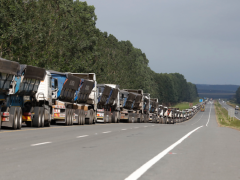
A new global web-based customs system implemented recently by the Zambia Revenue Authority (ZRA) has failed in its promise to “facilitate cross-border trade by enhancing clearing processes”. Instead, it is causing expensive delays and major frustrations, FTW has learned. The Asycuda World single window system – a United Nations Conference on Trade and Development (Unctad)- developed system – was initially rolled out to the Lusaka, Chirundu and Kariba border posts towards the end of last year, with the ZRA announcing it would be rolling it out to 19 other border posts throughout 2014. Last week the Customs Clearing and Freight Forwarding Agents Association of Zambia (CCFFAAZ) issued a statement calling for the ZRA to “seriously consider doing away with the Asycuda system”. Bruce Kaemba, president of the CCFFAAZ, stated: “The current system is unstable as it requires effective internet connectivity – an issue which the ZRA seems to have overlooked – and it is unsustainable. It might just plunge our country into a trade coma.” Kaemba added that the failure of the system – which is either very slow or not operational at all – means that agents are forced to submit entries after business hours or defer payment from importers bringing goods into Zambia. “The risk associated with this is that the importers given special delivery terms could default on payment owed, resulting in a loss of revenue,” he stated. Managing director of Kingfisher Freight, Alwyn Nel, told FTW that the company’s vehicles were stuck at the Chirundu border on “a number of occasions” last week, accruing demurrage costs while the system was not operational. “The standing time of vehicles is costing us hundreds of thousands of rands, not to mention the loss in production costs and revenue from delayed arrival of material or goods,” he commented. Nel said the issue then arose of who should shoulder the responsibility for the delayed shipment and from which parties the demurrage costs could be recovered. “Customs won’t pay and the transporters want their money, yet it is not the fault of the agents or the clients,” he said. Joseph Musariri, chief executive of the Shipping & Forwarding Agents’ Association of Zimbabwe (SFAAZ) and president of the Federation of Clearing & Forwarding Associations of South Africa (FCFASA) said that since the system represented a “significant” investment by the ZRA, there was little chance that it would do away with it. “In principle, the system offers numerous national trade benefits and we commend the initiative to modernise the customs process. However, we are aware there is a problem at the moment and urge all parties involved to be transparent regarding all the issues and challenges and try to find a collective solution,” he said. He also noted that Zimbabwe had implemented the same Asycuda system in 2010. “There were massive teething problems most of which have now been overcome,” he said. Musariri said that some of the challenges include a lack of proper training and sharing of information, clearing agents not having the right equipment, and a possible lack of server capacity. “Furthermore, it is counter-productive to play the blame game. As an industry, everyone has the potential to benefit from a world-class, fully operational system that cuts down on corruption and facilitates trade by fasttracking the customs process. If there are problems, we need to highlight them with the relevant authorities and hold them, and ourselves, accountable for finding a solution as soon as possible.” He added that the Zambian government also needed to be more transparent in terms of the process, providing up-todate information on problems and feedback on how, and by when, they plan to address the issues. “Furthermore, there needs to be a viable Plan B,” Musariri said. ● FTW approached the ZRA for comment and was promised a “full and comprehensive statement” but nothing had been received by the production deadline. INSERT The standing time of vehicles is costing us hundreds of thousands of rands. – Alwyn Nel CAPTION System failure… there are huge delays at the Chirundu border post in Zambia. Photo: TradeMark Southern Africa
New Customes system causes Zambia trade shutdown
Comments | 0
© Now Media. This content is protected by copyright and may not be adapted or republished. If you would like to discuss cooperation opportunities, please contact: editor@freightnews.co.za.