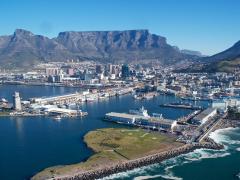
The Port of Durban’s seven new tandem-lift, ship-toshore (STS) cranes have failed to live up to their productivity promise, according to shipping line executives. Delivered in the last year and representing an investment of R700 million, they are still operating nowhere up to speed, according to our sources. These cranes are classed as megamax-sized, capable of handling ultra-large container vessels (ULCVs) like the world’s present largest. As Logan Naidoo, GM of capital projects at Transnet Port Terminals (TPT) said, they are capable of servicing the latest generation container vessels with a span of 24 containers across the deck. They are able to lift two x forty foot full containers or four x twenty foot (empty) containers in tandem, and with an 80 tonne safe working load. According to Glenn Delve, marketing director of shipping line MSC – by far the largest user of the Durban container terminal (DCT) facilities on Pier 2 – the potential tandem discharge on each crane is 35 moves per hour (mph). “When four of the new cranes are working a ship they will probably save a day on vessel turnaround timing – a healthy saving of approximately US$120 000 per vessel,” he added. But what has been their impact on productivity at the Durban container terminal (DCT) up to now? There has certainly been an improvement over the previous STS cranes which serviced the DCT berths on Pier 2. But that’s still way below the ultimate potential of the new units, according to MSC. “From an operational perspective, Maersk Line has seen significant improvements as a result of operating under the new cranes,” Craig Maulson, Maersk Line Southern Africa cluster operations manager, told FTW. But, said shipping line executive, Clint Carmichael: “Whilst there has been a productivity improvement with the new cranes, reliability and consistent higher move counts are not being achieved.” The efficiency and productivity is not as it should be, according to Delve. There are two reasons for that, he added. “The infrastructure to support the cranes is not yet up to speed,” Delve told FTW. “They can’t move containers to and from the cranes quickly enough.” The problem, he said, is that there needs to be more training and expertise amongst the crews operating the cranes and their support structure. “The current lack of skills,” Delve added, “is hampering full productivity.” He also highlighted the f luctuating nature of the loading/off loading operational speed. “They do as high as 30 moves per hour, and a low of about 20 mph. They’re still not maintaining a consistently high level of productivity. The growing pains, as it were.” INSERT The improvement over the previous STS cranes is still way below the ultimate potential of the new units. – Glenn Delve CAPTION The Port of Durban... tandem lifts able to lift two forty foot full containers or four twenty foot (empty) containers in tandem, and with an 80 tonne safe working load.
New cranes fail to meet productivity targets
Comments | 0
© Now Media. This content is protected by copyright and may not be adapted or republished. If you would like to discuss cooperation opportunities, please contact: editor@freightnews.co.za.