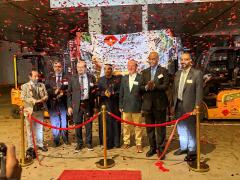
Two months since the official
launch of AMI Manica,
the new company’s
extended African
and global footprint
is already attracting
significant new
interest, says
managing director
Manica South Africa
and Botswana,
Wikus
Rudolph.
SA’s Bidvest Group sold
its shareholding in Manica
Holdings to Dubai-based
AMI International in
February, creating
a vast network of
owned offices
in Southern and
Eastern Africa.
But more than
that, for Manica the
merger opens a
new canvas
of
global
opportunities – with growth
in China and India the firm
focus, according to Rudolph.
The AMI takeover
currently incorporates
Manica SA, Botswana and
Zimbabwe – and within the
next month or two Manica
Zambia and Malawi will join
the fold.
“That will bring the whole
Manica group under the
AMI flag,” says Rudolph,
“providing an enviable
footprint in Southern and
Eastern Africa.”
He sees the international
leg as the most exciting
part. “We can now provide
a complete service – for
example from China to
Zambia and return. AMI’s
international network
includes China, India,
Pakistan and UAE.
“We can control the whole
leg and that is where we see
the opportunities. AMI has
always been very strong in
sea freight whereas from a
Manica point of view our
focus has been road freight.
We will now be in a position
to piggy-back on the AMI
agreements
with shipping
lines,” he says.
The major
focus will be
“anything
coming from
and going to
China.
“Now that
we have the
representation
in China it
should be a lot
easier to tie up some business
there. We also see India as a
growing market.”
And project cargo will
continue to play a key role,
says Rudolph.
“Manica has always been
strong in project cargo. We
are currently providing all
the logistics from Durban
for the Kazungula bridge.
There are currently a lot
of projects under way or in
the planning stage – largely
driven out of China – and we
see significant
opportunities
in that space.”
The next few
months will
see a period of
consolidation
as the merged
entities settle
into their
new identity.
The company
currently
outsources the
majority of its road transport,
but feasibility studies are
under way regarding the
acquisition of its own fleet.
Expansion of warehousing
facilities could also be on the
cards.
“Once we reach critical
mass we will consider all new
growth options.”
We can control the
whole leg and that
is where we see the
opportunities.
– Wikus Rudolph