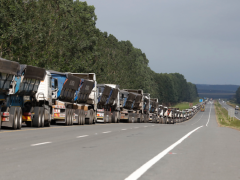
SA trade with Zimbabwe is unlikely to be much affected by the results of the recent controversial elections, and certainly unlikely to drop – because it’s already at the lowest of the low, according to freight industry executives who talked to FTW. “I just think it’ll be more of the same,” Anthony Dawe, MD of Bidfreight, told FTW. “It hasn’t been great recently, and nothing has changed. “It can’t get any worse, because it’s already at the bottom stop, and I certainly don’t see it getting any better.” Richard Szabo, MD of Kintetsu World Express, was of the same opinion. “I think it’s pretty much the same,” he said. He also saw no pressure on SA coming out of the new – or rather the old, but revived – government in Zimbabwe. “Nothing will change because the SA government is a supporter of (president Robert) Mugabe and Zimbabwe,” he added. Mike Brews, chief operating officer (COO) of marine underwriters, Associated Marine, held the same view. “There’s clearly a lot of worry about things in Zimbabwe,” he said. “But I don’t see a big drop in business being done.” But Dawe and Brews both expressed concern about Mugabe immediately latching on to Zimbabwe’s indigenisation policy. “This requirement for locals to have a controlling shareholding in foreign companies will always be a problem for business in Zimbabwe,” said Brews. Dawe felt the same, and with Bidvest interests in Zimbabwe in mind. “We have businesses up there, and obviously the indigenisation is a worry for us,” he said. And it’s certainly no passing fancy. Mugabe said immediately after the elections that he would target the remaining 1 138 white and foreignowned companies left in the country, as well as local banks with foreign interests, to hand over 51% of their businesses to the Zanu PF government. Zanu PF ran full-page advertisements in local papers, which read: “over the next five years, Zimbabwe is going to witness a unique wealth transfer model that will see ordinary people take charge of the economy.” And Savior Kasukwere, one of Mugabe’s ministers, revealed that the country planned to seize that 51% of foreign-owned mines – worth an estimated $7 billion – without any compensation. On the trade front, the country still remains a net importer of SA products with a trade deficit for the four months to April widening to US$1.6 billion, after Zimbabwe imported goods worth US$2.62bn against exports of US$1.02bn. The burgeoning trade gap has affected the recapitalisation of the manufacturing sector, whose capacity utilisation, according to the Confederation of Zimbabwe Industries, has declined to 44% and requires an estimated US$2bn to operate at full capacity. SA remained Zimbabwe’s biggest trading partner in the six months to June, with exports to that country amounting to US$1.1bn against imports of US$1.8bn, according to latest figures from ZimStats. The trade deficit between Zimbabwe and SA now amounts to US $779 million. Overall, Zimbabwe imported goods worthUS$3.9bn and exported goods worth US$1.5bn. The bulk of imports into Zimbabwe were made up of fuel, wheat and rice while exports from the country were mainly tobacco and minerals. Zimbabwe has even resorted to importing most of its food, among other things, amid closure of most industries. INSERT & CAPTION 1 The requirement for locals to have a controlling shareholding in foreign companies will always be a problem for business in Zimbabwe. – Mike Brews INSERT & CAPTION 2 Nothing will change because the SA government is a supporter of Mugabe and Zimbabwe. – Richard Szabo CAPTION Election queues ... southern African leaders have declared the elections"free and peaceful".
More of the same for SA-Zim trade
Comments | 0
© Now Media. This content is protected by copyright and may not be adapted or republished. If you would like to discuss cooperation opportunities, please contact: editor@freightnews.co.za.