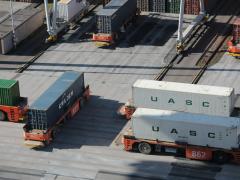
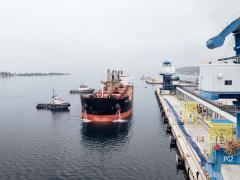
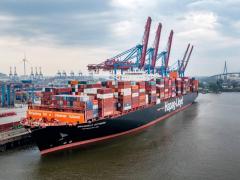
The increasing size of containerships in the last five years has lately reached vessel capacities that have been causing problems for the ports at which they call. Many of them were faced with a lack of water depth (draft), landside space, adequate capacity and size of handling equipment and staff skills, along with out-ofdate management planning methodology. And this led to serious inefficiencies and productivity problems at the guilty ports. This was not only on the main east-west trade – between Asia, the Mediterranean, North-West Europe and the US East Coast, and Asia and the US West Coast – where ships that now fit the current definition of the ‘megaship’ category now sail. But an offshoot problem has similarly been inflicted on the north-south trades, including our own in SA, thanks to the effect known as ‘cascading’. This is where what were previously the big ships on the main trades – vessels between 8 000 TEU and about 12 000 TEU capacity – began to be redeployed to other trades where capacity demand justified their use. Harbours on the northsouth trades, therefore, began to have these same inefficiency/ productivity problems, thanks to the same reasons that had bothered their bigger eastwest brethren. How much of a problem has this caused for SA, and particularly the main Port of Durban, which handles about 80% of this country’s container trade? FTW spoke to some of our contacts to see the extent of any problems. Not so much on the ocean side, according to Glenn Delve, SA marketing director of MSC. The seven new ship-to-shore (STS) cranes at the Durban container terminal on Pier 2 were handling the load adequately enough, although they could be quicker, in his opinion. “But, with the bigger vessels cascading here,” he added, “there is a landside situation occurring.” However, another line executive, who always wishes to be anonymous, did see one major problem area in Durban. This was with Transnet’s plans to deepen the berths, also dredging the entry channel to the berths and their turning basin, not yet having come to fruition. “So, with this draft issue, the bigger ships just can’t come in fully laden,” he added – and this reduced the cost efficiency and economies of scale of using bigger vessels. And bigger vessels were becoming common. “Apart from MSC, who was the instigator, Hamburg Süd and CMA CGM also have bigger vessels. Furthermore, China Shipping has introduced bigger vessels on its West African trade, but these are now by-passing Durban because of the draft issue.” He noted that Cape Town had also just handled its biggest ship ever – the 8 200 TEU, MSC Paris. With reference to the landside situation in Durban, Kevin Martin, MD of Transport and immediate past-chairman of the Durban Harbour Carriers Association (DHCA), said: “The bigger ships mean that more cargo goes to one tower. And this means the slower road transport’s going to be. “It’s always the case, because they (Transnet Port Terminals) are just not spreading the work load. “But we are talking to them about it.” On the main trades, the word megaship is now fitting vessels of 18 000 TEU upwards. The first of these in the latest ‘world’s biggest containership’ race was the first of Maersk Line’s series of Triple-E-class vessels, the Maersk Mc-Kinney Moller – launched on February 27, 2013, going into service that July. A Triple-E-class vessel has a capacity of 18 300 TEU, and is 400 metres long, 59m wide and 73m high. It beat its Maersk sister, Emma Maersk, for the ‘biggest’ title by 2 500 TEU. But this record was very quickly broken. In the last year to 18 months there has been a megaship buying frenzy. The current title holder is OOCL with six 21 100 TEU vessels on order. But how big can they get? Well, you can push as hard as you like, but FTW is not going to hazard a guess. We have heard a whole host of maximum feasible sizes from all sorts of shipping fundis, and just why that will be finally the biggest size possible. But it’s not worth taking any bets. There is currently talk in the marketplace of vessels up to 25 000 TEU in the not-sodistant future. There has even been chat about what is titled the ‘Malaccamax’ containership – called that because it would be the largest size of ship capable of fitting through the 25-metre-deep Strait of Malacca between the Malay Peninsula and the Indonesian island of Sumatra. And with a 20m draft to give adequate bottom clearance, such a ship could carry up to 30 000 TEU. So make your own guess. And, dealing with water depth, the other area where this is a maximum size factor coming into play is at the ports. In the Far East and Europe, the problem of water depth is not a serious one at most major ports. Also, pretty prompt investments in new cranes and other landside handling equipment, and a crash course in smarter terminal management, has overcome the initial problems they suffered from. Although the major lines are still insisting that in-port times are still way too high, and demanding even better productivity levels. But, the question of how to achieve sufficient water depth is a vexing one for many US ports, particularly on the East Coast. They are faced with bigger vessels on the transatlantic trade, and the prospect of bigger ones also coming from the Panama Canal when its upgrade is complete. The answer has been urgent dredging projects, which are still continuing, and big investments planned in terminal equipment. But the rapid increase in megaship sizes has also caused concern for port and terminal operators at the US West Coast ports, where they have the depth, but are currently contending with the difficulties wrought by the huge deliveries from these ships. So, dealing with larger vessels is not necessarily an insurmountable challenge, but changes to how the ports work are required for the supply chain to fully benefit from them. The megaship buying frenzy has also had, and still has, a problem for the lines. This capacity supply/demand problem is already noticeable, with rates at their lowest since mid-2013, and about half what they were at the beginning of this year. According an analyst’s estimate, the capacity in container shipping is at least 15% above demand. INSERT & CAPTION The bigger ships mean that more cargo goes to one tower. – Kevin Martin CAPTION Maersk Mc-Kinney Moller… the first of world’s biggest containerships.
Mega-sized containerships causing problems at ports
Comments | 0
© Now Media. This content is protected by copyright and may not be adapted or republished. If you would like to discuss cooperation opportunities, please contact: editor@freightnews.co.za.