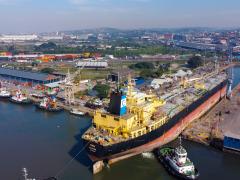
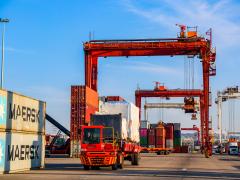
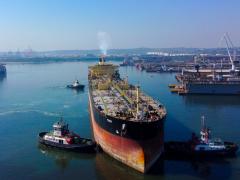
TERRY HUTSON RICHARDS BAY will score big if the proposed national port master plan, which goes before cabinet for approval later this year and then on a roadshow across the country early in 2006, is approved. The master plan proposes large scale container terminal development in a westerly direction and new breakbulk terminals and ship repair facilities created on land between existing berths and the small craft harbour, all on a scale not exceeded since 1976. In all over 20 additional berths will be provided for container ships, and the number of berths at the coal terminal will more than double to eight. The long term plan, which takes account of the portÕs strategic positioning closest to the countryÕs industrial heartland and mining regions, will see Richards Bay eventually race ahead of Durban as the countryÕs premier container port, not only in bulk cargo but also in breakbulk, neo-bulk and containers. The national master plan sets a cap on DurbanÕs container growth at about 8 million TEUs, which remains a long way off, but anticipates that Richards Bay has the potential to handle more than double that at 18m TEUs annually. Of most significance it appears that port planners have reaffirmed that geographic positioning matters more than ideology, and the Ngqura container terminal in the Eastern Cape is better positioned for transhipment cargo. Richards Bay Coal Terminal is already undergoing expansion by way of an additional berth that will assist the terminal to increase exports by 21% to 86mt annually within three years Ð an expansion that Trevor McGiddy, chief executive of South Dunes Coal Terminal has described as being too little to meet the demands of emerging, mostly black, empowered mines. He told a Cape Town conference last month (September) that ways of expanding beyond what was originally envisaged were under consideration. Of course like all plans the national master plan can only envisage what is possible, not necessarily what will happen. Parts will be tweaked and altered, other parts may never happen. But without such foresight any sudden surge in trade, as was experienced after 1994, will again take the ports by surprise, leaving inadequate infrastructure ill equipped to cope with booming volumes.
Master plan proposes massive container expansion for RB
Comments | 0
© Now Media. This content is protected by copyright and may not be adapted or republished. If you would like to discuss cooperation opportunities, please contact: editor@freightnews.co.za.