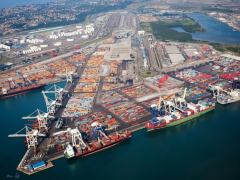
Ports of Southern Africa ... as R400m infrastructure upgrade gets into gear Leonard Neill MAPUTO HARBOUR has embarked on an extensive rehabilitation programme aimed at developing it into a competitive alternative to other ports in the southern African region. A total of R400 million is being invested in an infrastructural upgrade which is expected to be completed within three years. When Maputo Port Development Company (MPDC) announced earlier this year that its target was to restore to the international shipping world the credibility of Maputo as the natural and most efficient transit port for the southern African region, chief executive Tim Hansford was blunt in his appraisal of the situation. "The port has been handling small and rusted ships weighing less than 45 000 tons. Bigger and newer ships have not been coming here for fear of safety. Now our objective is simple. We have to change all of that!" MPDC plans to develop Maputo to compete with Durban for traffic. Already, during recent months, the pattern of improvement has emerged. The departure of 45 000 cartons of bananas destined from Mpumalanga to Libya in June marked a milestone in this respect. It was the first time Maputo had handled a commodity of this nature, and the first time in 50 years that South African bananas had been sold into the export market. The fact that 12 separate growers had contributed to the consignment showed the confidence of Mpumalanga exporters in utilising the Maputo facility. Now a total of 70 000 pallets are expected to go through Maputo in the current season. Earlier in the year The province's largest sugar mill, TSB decided to switch its bagged sugar exports from Durban to Maputo and moved some 30 000 tons in the past season. Satisfied that Maputo's loading capabilities and standards have now reached approved levels after recent refurbishment, mill authorities decided to switch ports of loading, with the nearer Maputo harbour cutting a good deal in transportation costs. Bulk transport of molasses and brown sugar for the same mill are now moving through the harbour, while the first shipments of 600 tons of citrus fruit have also been loaded in Maputo. Timber exporters are now in consultation with the port authorities with a view to moving their exports through the harbour. MACS, with its multi-purpose vessels, is still the only dedicated container-carrying line of any note which has Maputo on its regular schedule, but indications are that this will change shortly as other lines view the possibility of regular calls there. Ignazio Messina has added Maputo on its northbound schedule from South Africa to the Mediterranean, calling every 28 days. The line deploys ro-ro vessels on the service offering both containerised and breakbulk capacity, while Unicorn has restructured its Mozambique service with a weekly Durban-Maputo-Nacala-Beira-Durban service. Now, with the opening up of the Maputo Corridor, allowing greater and easier access from both Mpumalanga and Gauteng, port authorities are confident of making great strides in capturing both import and export business from those regions in the next few years.
Maputo takes on Durban
Comments | 0
© Now Media. This content is protected by copyright and may not be adapted or republished. If you would like to discuss cooperation opportunities, please contact: editor@freightnews.co.za.