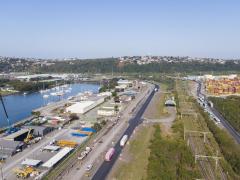
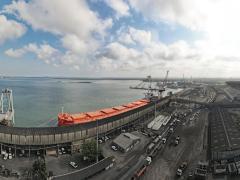
All companies along the logistics chain will be revisiting their plans and strategies with the announcement by Solly Letsoalo, chief operating officer of Transnet Port Terminals (TPT), that Ngqura is to be the hub port for South Africa (FTW July 10, 2009). With a design capacity of 10 million TEUs a year, the hub port will feed other harbours in South, Southern, Eastern and Western Africa, in addition to handling south-south and north-south transhipment cargo. Shipping companies have been waiting for a clear signal from Transnet about its intentions for Ngqura, which was built for political rather than pure economic reasons. As it turns out, the early studies on the viability of the Coega Industrial Development Zone and its deep-water port have been backed by Transnet’s own research which, according to Letsoalo, identified Ngqura as the best place for a hub port. Implicit in the designation of Ngqura as the hub is a scaling down of future investment in other harbours, as Ngqura will be the only port capable of handling the new generation container ships. “Ngqura should grow to be the biggest port in South Africa, the most cost-effective, and the one handling the highest number of containers,” he said. For shipping and logistics companies, this means that more attention will have to be paid to operations in Port Elizabeth, Coega and Ngqura. UPS and PE Cold Storage are the two logistics companies to invest first in the adjacent Coega IDZ. With the announcement of the hub status of Ngqura, the Coega Development Corporation CDC expects much more interest in its logistics zone. Separate research undertaken for Transnet (by Flynn Consulting) and the CDC by IBM Consulting have identified opportunities for value-added logistics, as well as conventional warehousing. Situated as it is at the centre of the world’s major markets and component manufacturing zones, Coega is well positioned for assembly (3PL and 4PL) operations.
Logistics focus shifts to Ngqura
Comments | 0
© Now Media. This content is protected by copyright and may not be adapted or republished. If you would like to discuss cooperation opportunities, please contact: editor@freightnews.co.za.