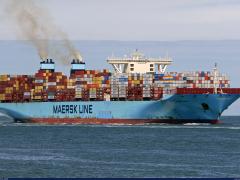
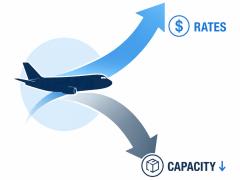
The world’s two main sea trades are running out of steam – with trade volumes slackening off dramatically after last year’s encouraging revival, and freight rates plummeting. The shipping lines spent last year and well into this year rapidly increasing tonnage on almost all their services in the face of a suddenly booming market, but are now suffering from serious uncertainty as overcapacity on all main trade routes has led to poor utilisation levels and severe rate erosion. It has been especially noticeable on the Asia- Europe and the trans-Pacific Asia-US West Coast trades – by far the top two seafreight routes – with the benchmark figures in the Shanghai Containerised Freight Index’s spot rate having been on the decline for some weeks, and the lines gloomily watching incomes reaching dangerously close to unsustainable levels. Indeed, some trans- Pacific carriers have already decided that unsustainability has already arrived, and have started tonnage cutbacks – revealing a trend that FTW pointed out in a previous issue, where lines react much more quickly to diminishing market demand and pull tonnage off ailing trades far faster than they ever did in the past. The Chilean shipping line, CSAV, has become the latest container carrier to begin withdrawing capacity from the faltering east-west trades as rates continue to decline amid stagnant freight volumes. The company said it was suspending its 11-ship Asian service between the Indian subcontinent, Southeast Asia, China and US West Coast over the course of this month, blaming poor market conditions. And, although the idle boxship fleet is at its smallest for three years, research by Paris-based analyst, Alphaliner, has raised fears that more vessels could be mothballed as overcapacity hits main trades. At the beginning of June, Alphaliner recorded only 63 idle ships, the equivalent of 80 000 TEUs. It expects the figure to fall by a further 20 000 TEUs in the next few weeks. However, it warned that if demand failed to pick up strongly in the next two months, the return of surplus ships by charterers could lead to an increase in the idle fleet by September. “While the idle fleet has diminished due to the high demand for containerships in the first half of this year, the outlook remains uncertain,” it said. “Low utilisation levels on a number of key routes and non-compensatory freight rates could force carriers to scale back deployed capacity later in the year.” Alphaliner also pointed out that utilisation on the key trades and Far East-Europe routes has stubbornly remained below 90% in the past four months, which led to a severe reduction in spot market freight rates. “CSAV’s sudden announcement of the suspension of the Far East- US West Coast service could signal the start of a reversal of the recent high demand for tonnage,” added the analyst.
Lines react fast to shrinking volumes
Comments | 0
© Now Media. This content is protected by copyright and may not be adapted or republished. If you would like to discuss cooperation opportunities, please contact: editor@freightnews.co.za.