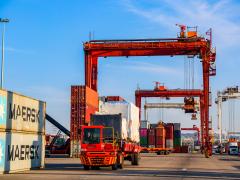
SHIPPER-OWNED containers continue to be the ideal solution for getting project cargoes into Africa, according to Barron Charsley, director of container supply and conversion specialists, Container World. “For example,” he said, “with the significant increase in the price of commodities, SA mining houses are stepping up their exploration in Africa – with new mining and drilling sites springing up all over the continent.” This has created a burgeoning market for the supply of a wide range of containers – units that are vitally necessary for the movement of parts, equipment and materials to many of these rather remote sites. “With the containers usually also destined to remain permanently on site, for storage or workshop purposes, for example,” said Charsley, “shipper-owned units are a most cost-efficient answer.” It also overcomes another problem, according to Marius Calitz, sales director of Unitary Air- Conditioning Distribution, which has been using mixes of open-top and standard boxes acquired from Container World for a series of project shipments into Angola. “Lines just don’t keep specialised equipment – like open-tops – in stock,” he told FTW. “And if you can get them, you’ll have to pay through the nose.” Also, ships sailing into West Africa can spend 40- 60 days waiting to get into the congested seaports up that seaboard, and boxes can take months to be returned. “Lines charge demurrage until they get their containers back,” said Calitz. “So it’s better to own your own equipment. Unitary’s latest shipment was forty-six 40-foot (12-metre) containers – a mix of standard and open-top – delivering an order for pre-fabricated warehouses into Luanda in Angola. Clive Brickhill, project manager for Madagascar at the clearing and forwarding (c&f) specialists SDV, also noted the shortage of specialised equipment offered by shipping lines. He is also a proponent of shipper-owned boxes. This has proven particularly true in one of his company's latest project shipments – the ongoing closed-loop movement of 50 open-top 40-ft (12-m) container loads of goods from SA to Madagascar and back. “First, it is moved by road from Johannesburg to Durban; by sea to Madagascar; on to barges for landing on-shore; then by road transport to its final destination on the island. That’s a lot of handling. In breakbulk, the logistics exercise would be much more difficult. But as a containerised project, the cargo arrives safely and undamaged.” In recent years, Container World has supplied containers for the shipment of project cargoes into the likes of Mozambique, Madagascar, Nigeria, Angola and Uganda. “It generally tends to be clearing and forwarding (c&f) companies that are focused on the movement of these cargoes,” said Charsley, “and they tend to be our clients – not the end users.” And to meet this demand, he added, Container World has a good supply of quality containers – open tops, flat racks, high cube and general purpose (GP) units.
Lines often short of specialised equipment
Comments | 0
© Now Media. This content is protected by copyright and may not be adapted or republished. If you would like to discuss cooperation opportunities, please contact: editor@freightnews.co.za.