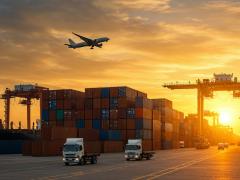
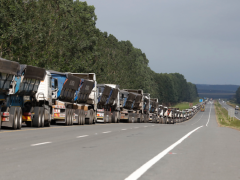
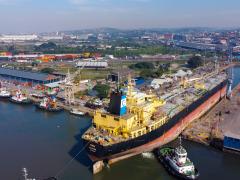
HOW CAN we position our ports, our infrastructure and our transport and logistics to take advantage of a very good global environment? That was the question posed by Transnet CEO Maria Ramos at last week’s Intermodal Africa 2007. “We know that one of the key elements that differentiate developed and developing countries is the cost of inputs – and those costs are primarily energy, telecommunications and transport and logistics. “In South Africa we’ve always had a pretty good energy environment, but transport and logistics costs are too high. And the efficiency of our ports is clearly one of the most important elements in the chain.” According to Ramos, a World Bank report estimates that bad ports are the equivalent of being 0% further away from markets for an average country. “South Africa, because of its geography, with the bulk of economic activity based in Gauteng, will always be transport-intensive. “And if you think how transport-intensive it is in relation to the population size, you see how important it is to get the intermodal logistics chain working more efficiently.” In terms of export corridors, BMW’s manufacturing takes place in Rosslyn and has to be exported a long distance to the ports. “This leads to long export and import corridor requirements.” Add to that the ocean freight costs which were estimated in a recent study to account for 73% of the total logistics costs in SA. Clearly waiting time and pre-berthing intervals for ships must be addressed to ramp up port efficiency, but at the same time better information on ETAs for ships in and out of the ports is critical “We are making good progress with our business partners in this regard,” she said. In terms of rail costs and efficiencies, a benchmarking exercise undertaken by Spoornet revealed that South Africa’s rail costs, based on a per ton per kilometre rate, were among the cheapest in the world, said Ramos. But the crux is whether the train reaches the port and offloads the containers within a reasonable period of time, and here she concedes that it takes too long. Clearly we’re all on the same page in terms of needs and methodology in order to ramp up supply chain efficiency. What we need is a collective effort to translate good intentions into practice, she added.
'Let's work together to ramp up efficiency' – Ramos
Comments | 0
© Now Media. This content is protected by copyright and may not be adapted or republished. If you would like to discuss cooperation opportunities, please contact: editor@freightnews.co.za.