While a fragile ceasefire in the Persian Gulf has brought some measure of calm to the Middle East conflict, the supply chain industry in South Africa is facing a much older assault that seems to have drifted out of the public eye – crime against road freight.
According to Dr Barbra Duri, a senior researcher at the University of Johannesburg’s (UJ) Institute for Transport and Logistics studies, South Africa’s transport system is being stressed by growing demand patterns, and one of the biggest drivers of that demand is e-commerce.
Speaking at a Transport Forum event hosted by the university’s Department of Transport and Supply Chain Management, she said that changing consumer behaviour was extending beyond road haulage to affect ports and airfreight, encompassing digital exploitation – and, since the emergence of artificial intelligence, includes AI‑driven attacks on logistics.
Given what’s happening, Duri said the need for an ongoing conversation around safety and security in the transport industry “is critical”.
Data used in support of her argument sketches a bleak story.
In the first quarter of 2025, 420 truck hijackings and 2 670 cargo theft incidents were recorded.
The modus operandi of syndicates targeting the industry, Duri said, involved GPS jamming, fake police stops and insider collusion, while Gauteng and the N3 Corridor to the Port of Durban were identified as hot spots.
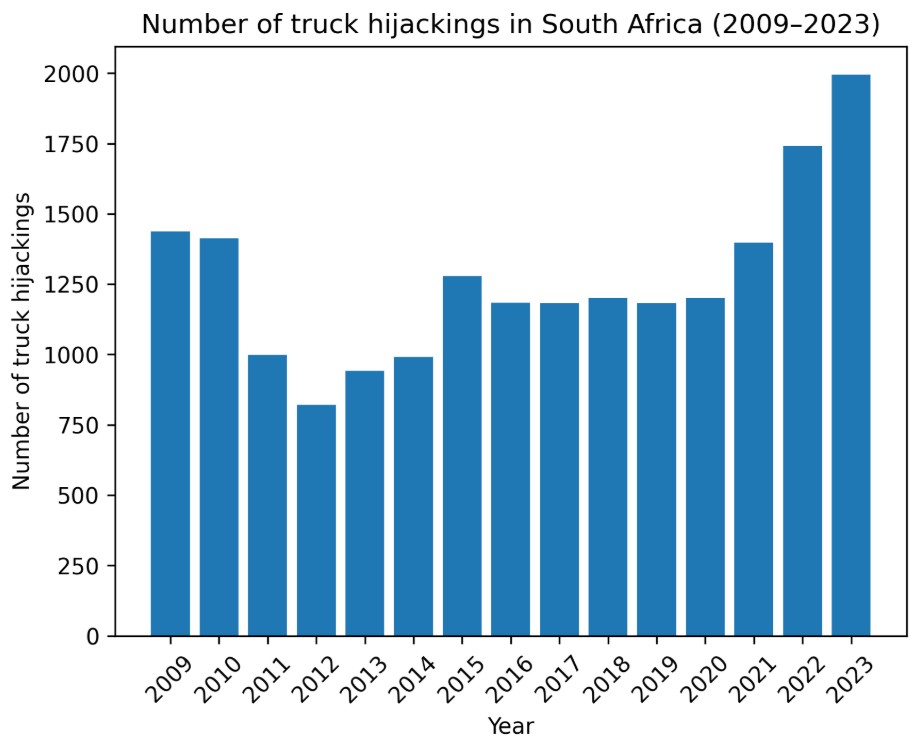
A graph of truck hijackings in South Africa going back to 2009 shows peaks of almost 1 500 incidents in 2009 and 2010, followed by four years of 1 000 incidents or less, a slight uptick in 2015, a plateau of less than 1 500 incidents per year till 2020 and then a sharp increase from 2021 onwards to about 2 000 incidents by 2023.
Since then, e-commerce continues to grow, reaching R71 billion in 2023 and expected to exceed R100bn before the end of this year.
Looking at crime trends, Duri said last-mile logistics was expected to be targeted even more than it currently is, especially where landed airfreight is moved from a warehouse and onto customer destinations.
As for the country’s ports, Duri said South Africa served as a critical maritime gateway to the wider region, and syndicates were exploiting the country’s port infrastructure.
Multimodal risks, she added, “are no longer isolated.
“They are interconnected, evolving, and increasingly sophisticated across road, rail, air and digital systems”.
But although transport crime is so pervasive, road freight in South Africa attracts most assaults because it carries the lion’s share of domestic cargo – as much as 85%.
“It is the backbone of the economy,” Duri said.
“It supports almost every part of the country's economic activity and the sector contributes approximately 10-12% of South Africa's GDP. Yet, the very same system that sustains the economy is becoming increasingly exposed and vulnerable.”
Figuring out where the fight against transport appeared to be lost demanded urgent self-reflection by industry about what was really failing, she said.
Is it fragmented responsibility across stakeholders?
Is it integration between physical and digital security?
Is it reactive rather than predictive risk management?
Or maybe it’s siloed operations across modes.
In a worst-case scenario, it could even be all of the above.
Ultimately, the logistics industry as a whole, and specifically the road freight sector, should ask itself whether it’s doing enough against the cargo crime onslaught, Duri implored.