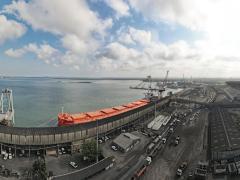
Bulk exports of iron ore from SA showed a massive growth of 41.1% in the recession year of 2009, and kept pace with the increasing demand in China of 42.5%, according to a study conducted by Iain McIntosh, trade and marketing director of Mitsui OSK Line (MOL) in SA, and commissioned by Dry Cargo International. China’s ore demand went up from 438-million tonnes in 2008 to 624-mt in 2009; but the demand in the rest of the world (ROW), meantime, plummeted by 25% from 408-mt in 2008 to 308-mt in 2009. As China is the main driver of SA iron ore export demand this trade looks set to grow further in forecast years ahead, the McIntosh study added, although the pace will slow. The annual percentage growth in demand from China will be: from 2008- to-2009, 42.5% (actual); 2009-10, 4.65% (estimated); 2010-11, 11.49% (e); 2011- 12, 10.71% (e). Growing from the actual 438-mt of 2008 to the estimated 806-mt of 2012, the overall 5-year growth in Chinese demand would be 84%. The annual percentage growth/loss in demand from the ROW will be: 2008-09, -25% (actual); 2009-10, 18.5% (estimated); 2010-11, 5.75% (e); 2011- 2012, 3.8% (e). Dropping from the actual 408-mt of 2008 to the estimated 401-mt of 2012, the overall 5-year decline in ROW demand would be -1.72%. The annual percentage growth in SA’s exports will be: 2008-09, 41.1% (actual); 2009-10, 11.4% (e); 2010- 11, 10.6% (e); 2011-12, 9.9% (e).Growing from the actual 31.6-mt of 2008 to the estimated 60-mt of 2012, the overall 5-year growth in SA exports would be 89.9%. Given that SA is forecast to grow its exports in line with China’s increasing demand, the slowing overall demand in the ROW is most likely to hit the traditionally big global suppliers, Brazil and Australia. In the iron ore supply league, SA currently ranks as 9th in the world with reserves of 5 370-mt. “However,” McIntosh told FTW, “if you add the further 26 400-mt of lower grade ore, we move to 6th in the world.” As such the SA supply of seaborne trade is relatively small, “but not insignificant” he added. “Its position on the global sphere also puts it in a relatively competitive position for both Atlantic and Pacific basin trading – and growth in exports over recent years has been at a faster pace in percentage terms against global growth.” Where it suffers a positional disadvantage is in the landside distance from its mines to the port of export. “The supply of ore comes largely from the Sishen field in the Northern Cape,” said McIntosh, “and is all exported via the Orex rail line [861-kilometres long] through the bulk port of Saldanha. “The distance the ore travels mine to port is 2-3 times longer than in the major competitors, CVRD Brazil and BHP Australia. The next critical issue is SA production being able to keep up with growing demand for exports. The bulk of the supply comes from the two ore companies, Kumba Iron Ore and Assmang. They together have a current production capacity in excess of 60-mt per annum – but with further capacity available to meet any growing demand. If you look at the graph showing Chinese and ROW demand and SA export output, you’ll note that this 60-mt mark is only estimated to apply from 2012. On the export side from SA, the demand will be an estimated 49.7-m this year; 5.5-mt in 2011; and that 60-mt in 2012. But there’s also a sneaky sideline requirement for ore – with local demand for SA steel production running at over 12-mt per annum. Add that to each year’s expected export demand, and that 60-mt breakline suddenly gets more critical. But the mines say their annual production capacity is 60-mt plus some.
Iron ore exports show dramatic growth
Comments | 0
© Now Media. This content is protected by copyright and may not be adapted or republished. If you would like to discuss cooperation opportunities, please contact: editor@freightnews.co.za.