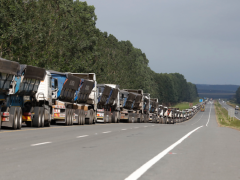
Despite reports to the contrary, the road-to-rail switch appears to be making less headway than we are led to believe. Working purely on the figures of container movements through the Port of Durban (which handles about 80% of SA’s container throughput), Dave Watts, maritime director for the SA Association of Freight Forwarders (Saaff), came up with contrary figures. From the Transnet Port Terminals (TPT) monthly key performance indicators (KPI), Watts deducted the numbers of transhipments that don’t move landside. Given that, his calculations showed that the actual rail uplift (excluding transhipments) from the Pier 2 Durban container terminal (DCT) in this financial year was 24.8% in April; in May 20.7%; in June 21.7%; in July 18.3% in August 17.1% and in September 18.0%. “That’s a drop of 27% over six months of rail traffic,” said Watts. “I can’t get my mind round why this is happening, although the words ‘inefficiency’, ‘delay’ and ‘cost’ are loudly expressed by container movers. “Clearly Transnet Freight Rail (TFR) is not making any progress as regards moving containers from road to rail – at least not on the Natcor line between Durban and Gauteng.” However, one story that has been doing the rounds may explain at least part of this railroad switch. A newspaper report came up with interesting statistics, revealing that 40% of the cargo from Durban harbour to Gauteng is transhipped from the containers in Durban and hauled to Gauteng on flatbed trucks. The reason for this is that most imports into Gauteng are in 40 foot (12 metre) containers, but exports are mostly in 20ft (6m) containers. To save having a massive oversupply of 40ft containers in Gauteng, and the expense of shipping empty 40ft boxes back to Durban or paying excessive empty turn-in charges in Gauteng , the cargo owners are emptying and leaving the big boxes in Durban. An industry comment to this was that this trend, which is apparently growing, would neutralise or minimise Transnet’s attempts to move cargo from road to rail. “Whatever the case,” said Watts, “it is certain that Transnet’s claims of growing volumes being shipped by rail just don’t hold water. “How are they coming up with these figures?”
Interesting transhipment anomaly on Durban-Jo'burg route
Comments | 0
© Now Media. This content is protected by copyright and may not be adapted or republished. If you would like to discuss cooperation opportunities, please contact: editor@freightnews.co.za.